Picture of the world in a sidewalk
Need a quick dose of geology? Go outside and look at a sidewalk. These human-made rocks offer a lot –from insights into weathering and erosion to regional geology and Earth History.
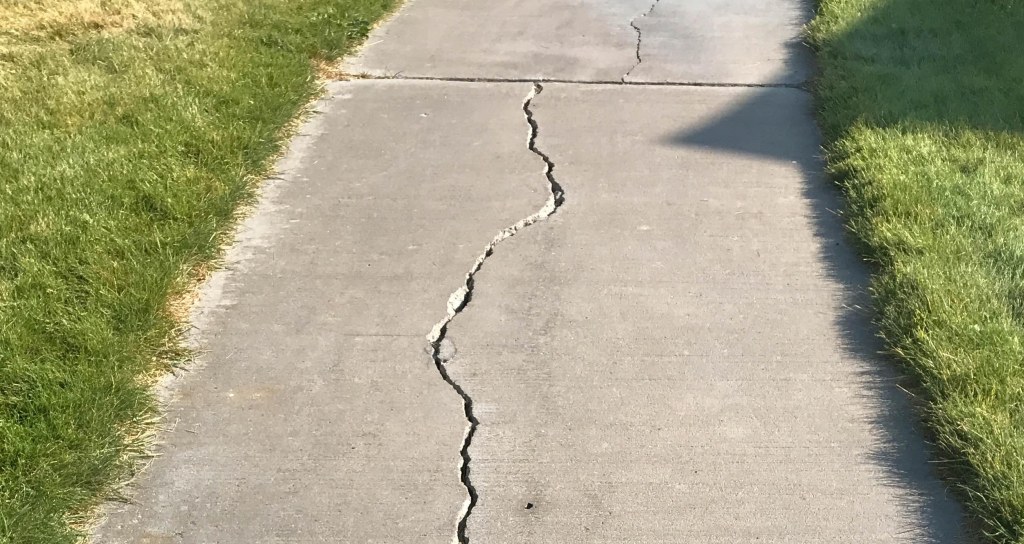
When I was 19 years old and just entering the geology major, I used to marvel at how sidewalks cracked. In front of me, almost in real time, geological weathering processes were at work, mostly through growing tree roots, differential settling of a sidewalk’s base, or a host of other processes that in Colorado typically included frequent freeze-thaw cycles. At the same time, other processes, aided by the water trickling into the cracks, were breaking down the concrete chemically. Suddenly, abstract concepts of physics and chemistry became real. I transformed from a science phobe to a science geek.

I’m still hooked on sidewalks. Not as much on their cracks, although they still fascinate, but the concrete itself. Consisting of gravel and sand—collectively called aggregate—as well as cement, which binds it together, this human-made conglomerate tells stories of landscapes dominated by volcanoes to coastlines to deserts. You just have to look at it.
But the aggregate can be hard to see. It’s frequently hidden beneath a fine cement-rich zone called the “float”, which typically rises to the surface when the concrete is poured and workers smooth over its top surface. Through wear and natural degradation, however, the aggregate gradually shows through. Those cracks I used to admire also expose the aggregate and can even act as small fault zones, allowing one side to shift relative to the other. Where the shifting poses a hazard to pedestrians, city crews sometimes grind the protruding edges to reveal a beautiful mosaic of differently colored, rounded pebbles, surrounded by a finer matrix of sand and cement.

Each of those pebbles has a story. Consider the close-up photos above: the one on the left shows a rectangular chip I cut from a larger piece of concrete; the central photo shows the chip mounted on a microscope slide and ground thin so that it can transmit light (a “thin section”); the photo on the right shows a microscopic view of the little rectangular area near the left-bottom corner of the other photos. It appears in all its glory below!
Read more…
