geologictimepics

Geology and Geologic Time through Photographs

Archive for the category “essay”

Picture of the world in a sidewalk

Need a quick dose of geology? Go outside and look at a sidewalk. These human-made rocks offer a lot –from insights into weathering and erosion to regional geology and Earth History.
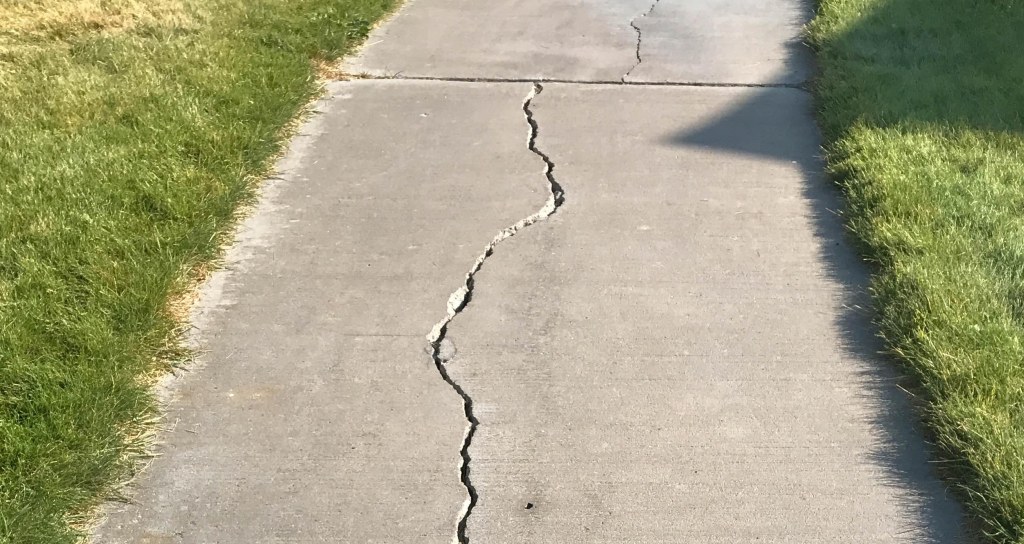
When I was 19 years old and just entering the geology major, I used to marvel at how sidewalks cracked. In front of me, almost in real time, geological weathering processes were at work, mostly through growing tree roots, differential settling of a sidewalk’s base, or a host of other processes that in Colorado typically included frequent freeze-thaw cycles. At the same time, other processes, aided by the water trickling into the cracks, were breaking down the concrete chemically. Suddenly, abstract concepts of physics and chemistry became real. I transformed from a science phobe to a science geek.

I’m still hooked on sidewalks. Not as much on their cracks, although they still fascinate, but the concrete itself. Consisting of gravel and sand—collectively called aggregate—as well as cement, which binds it together, this human-made conglomerate tells stories of landscapes dominated by volcanoes to coastlines to deserts. You just have to look at it.

But the aggregate can be hard to see. It’s frequently hidden beneath a fine cement-rich zone called the “float”, which typically rises to the surface when the concrete is poured and workers smooth over its top surface. Through wear and natural degradation, however, the aggregate gradually shows through. Those cracks I used to admire also expose the aggregate and can even act as small fault zones, allowing one side to shift relative to the other. Where the shifting poses a hazard to pedestrians, city crews sometimes grind the protruding edges to reveal a beautiful mosaic of differently colored, rounded pebbles, surrounded by a finer matrix of sand and cement.

Each of those pebbles has a story. Consider the close-up photos above: the one on the left shows a rectangular chip I cut from a larger piece of concrete; the central photo shows the chip mounted on a microscope slide and ground thin so that it can transmit light (a “thin section”); the photo on the right shows a microscopic view of the little rectangular area in the other photos. It appears in all its glory below!
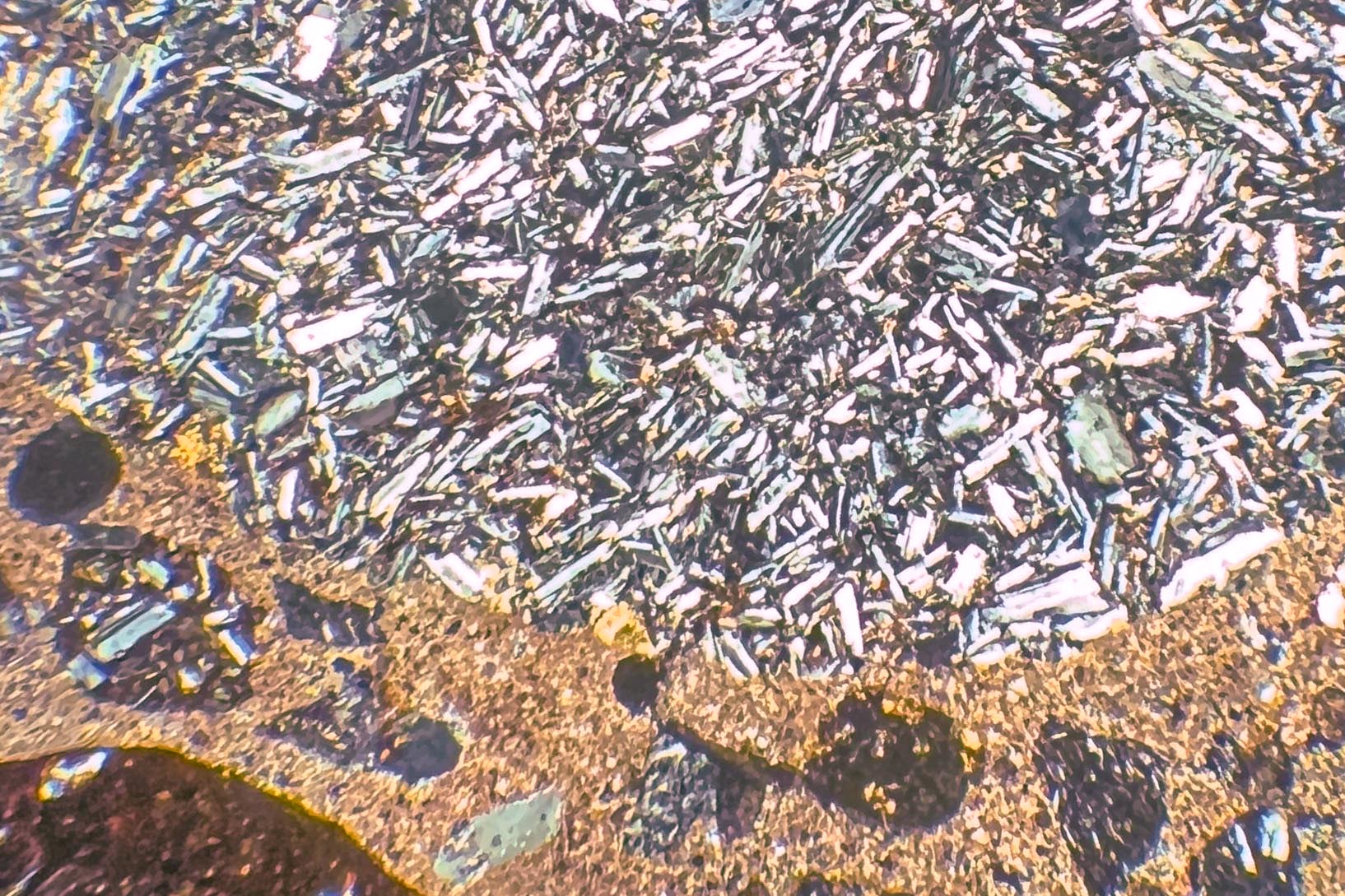
Photomicrograph of concrete. Note the crystalline nature of the pebble that makes up the upper two-thirds of the image; the brown material below it is cement with suspended sand grains.

Study that image: a typical pebble encased in concrete that we typically pay no attention to –and it’s beautiful! How can it not tell a story? Notice how the pebble is made entirely of crystals, oriented in a random fashion, telling us it cooled from a liquid state—the hallmark of igneous rocks. And the crystals are so small, the rock must’ve cooled quickly –on Earth’s surface as a volcanic rock. In contrast, intrusive igneous rocks, which cool and crystallize beneath Earth’s surface, consist of larger, easily visible crystals. (see my post on rock identification for examples).

By the same reasoning, I can tell that the many dark gray to black pebbles—or the gray-greenish ones, all so common in the sidewalks where I live in Eugene, Oregon—are also volcanic.  And it makes sense. Eugene gets most of its aggregate from a group of giant gravel quarries just north of town near the confluence of the Willamette and McKenzie Rivers. Those rivers drain the western Cascades, which was an active chain of volcanoes from about 40-5 million years ago, and the High Cascades, which are active today. These pebbles are now rounded because they were transported by the river. Before that, they formed parts of larger and much more angular rocks that broke off outcrops somewhere up the McKenzie or Willamette drainages. Those outcrops were part of the lava flows that built the range.  
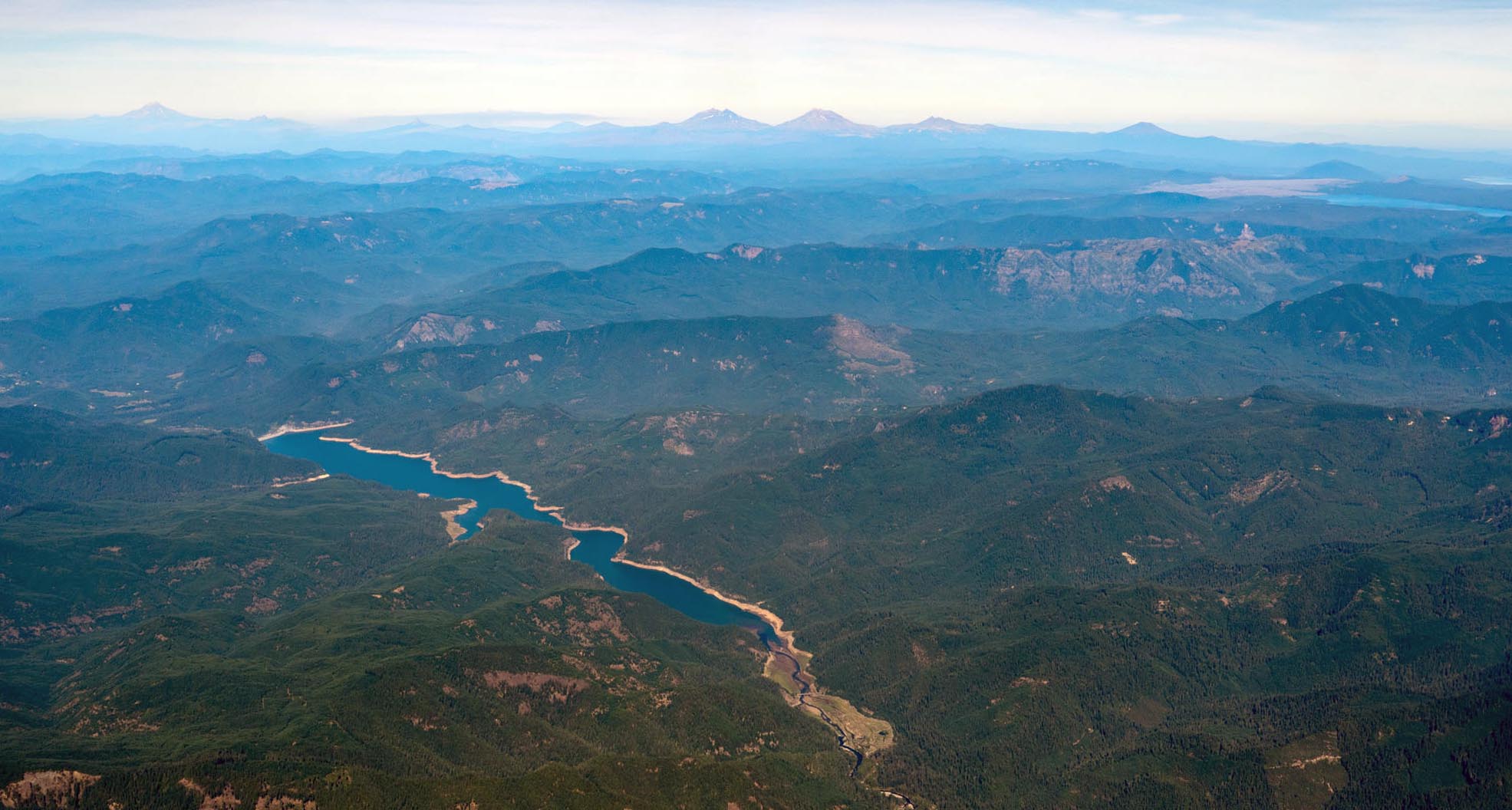
Aerial view of the western Cascades with the presently active High Cascades on the skyline, Oregon. The many cliffs of the western Cascades consist mostly of lava and ash flows and other volcanic rocks.

Those black pebbles are mostly basalt, which typically form in relatively quiet eruptions like those on Hawaii or Iceland. The gray-green ones are mostly andesite or dacite, which can reflect more violent eruptions, like what happened at Mt. St. Helens some 45 years ago. I also see some red-colored basalt pebbles—red because of iron oxidation—some coarsely crystalline intrusive igneous pebbles, and even some rare sandstone pebbles, all of which have sources in the Cascades. And there are plenty of rocks that are very fine grained and featureless and so practically impossible to identify. I had a geology prof in college who would call rocks like that “FRDKs” –or “Funny Rock Don’t Know”.

Of course, other rock types make up the Cascades, mostly ash flow tuffs, pumice fall deposits, and cinders, which are all volcanic. There is even some sandstone and shale. But these rocks tend to fall apart easily during the rigors of river transport and so appear only rarely in our sidewalks. So, my sidewalk only tells a partial story of the Cascades. Still, it’s not bad, given that my favorite “exposure” lies just down the street!

As the most used natural resource aside from water, concrete is pretty much everywhere humans live, so you can play this game just about anywhere you go. In fact, some of my favorite sidewalks are in southwestern Montana, where locally sourced gravel includes red, green, white, and tan quartzite pebbles. These pebbles come largely from rocks of the Belt Supergroup, which accumulated in a large inland sea between about 1.4 and 1.47 billion years ago. Rocks of the Belt Basin make up the incredible peaks and ridges of Glacier National Park in Montana. They extend all the way west to Spokane, Washington, north into Alberta, Canada and south beyond Salmon, Idaho. The bedrock erodes into such beautiful pebbles that it’s even sold in Eugene as “Rainbow Gravel”.
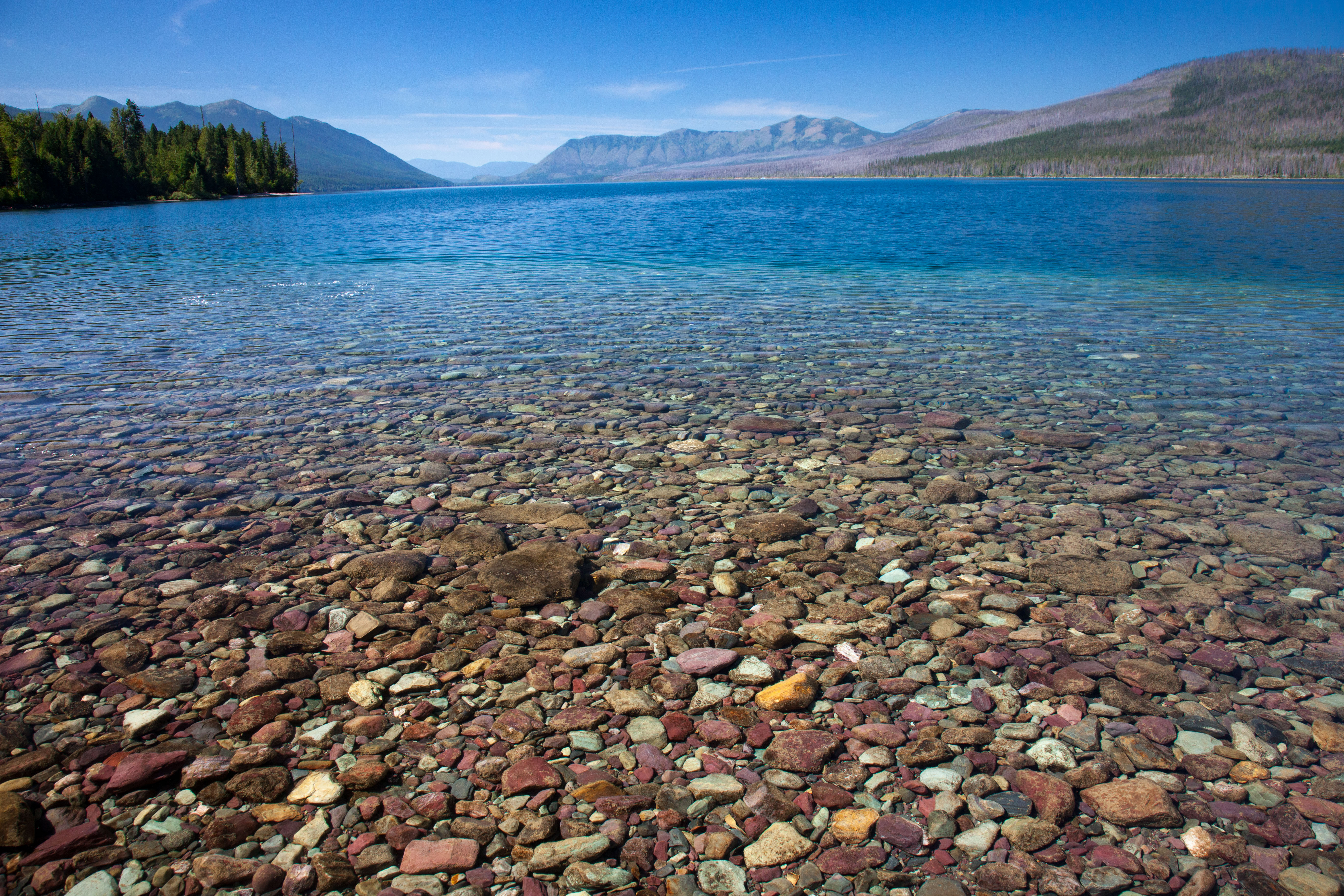
Cobbles and pebbles of the Belt Supergroup, eroded from the mountains of Glacier National Park, Montana.

It’s the same with natural conglomerate. The pebbles and cobbles that populate the “clast content” of a conglomerate present a partial image of the landscape when those sediments were deposited. The base of the Kootenai Formation in southwestern Montana, for example, hosts a conglomerate that’s about 120 million years old. It’s full of chert and quartzite pebbles derived from the much-older Phosphoria and Quadrant Formations. Their presence in the conglomerate indicates mountain-building was taking place in the west about 120 million years ago because the two older rock units, once buried beneath more than 1000 feet of younger rock, had to be exposed in the source area.

Eagle Mountain Formation

In some cases, a particularly unusual rock type exists in the mix, which allows researchers to trace it back to its specific origin. In the Amargosa Valley of California–just east of Death Valley National Park—you can see large pieces of granite in conglomerate of the 15-11 million-year Eagle Mountain Formation. The granite is uniquely tied to exposed granites near Hunter Mountain, some 60 miles away, so we know that the river carrying the gravel had to drain the Hunter Mountain area. In eastern Oregon, the Goose Rock Conglomerate, which is some 100 million years old, contains cobbles that were derived from a granite source in Idaho some 100 miles to the east.

A few years ago, while scrambling around on some conglomerate in Death Valley, I found a boulder that itself was made of conglomerate: a conglomerate within a conglomerate! Think of its history. The clasts within the conglomerate boulder were made of a variety of sedimentary rocks, mostly limestone and dolomite with a few scattered quartzite pebbles. They originally formed during the older part of the Paleozoic Era, between about 400 and 540 million years ago or even before. Those were times when this part of North America was mostly submerged beneath shallow ocean waters, interrupted by brief periods of emergence. A thriving ecology produced thick deposits of lime mud on the sea floor, which formed the limestone and dolomite; deposits of sand, which became quartzite, formed during the periods of emergence.

Conglomerate boulder in conglomerate of Miocene Furnace Creek Formation, Death Valley, CA

Those pebbles, each with their own rich histories, were eroded and transported away from their original sites, deposited together, buried by more sediment, then compacted and cemented into the original conglomerate (step 2 below). As that conglomerate was re-exposed, probably because of some local uplift, it too eroded into loose rocks of varying sizes– and those boulders and cobbles were pieces of conglomerate. Some of those rocks were transported and deposited along with other sediments, which were compacted and cemented into conglomerate of the Furnace Creek Formation. The Furnace Creek Formation, which is only some 3.5 to 6 million years old, has been uplifted and tilted and is weathering and eroding today.

Generalized sequence of events inferred from finding a conglomerate clast in a conglomerate.

Everything at Earth’s surface eventually breaks down physically and chemically, exposed rock and sidewalks alike, which brings me back to my original fascination. We can see it happening. When sidewalks decay, we replace them with new concrete, starting the process all over again.  While most of the worn, broken concrete now gets recycled, a lot doesn’t, and it ends up in our landfills, fields, streams, or beaches. Some of that concrete will get preserved along with other sediment, preserving an incomplete, yet intriguing picture of today’s world –and what came before.
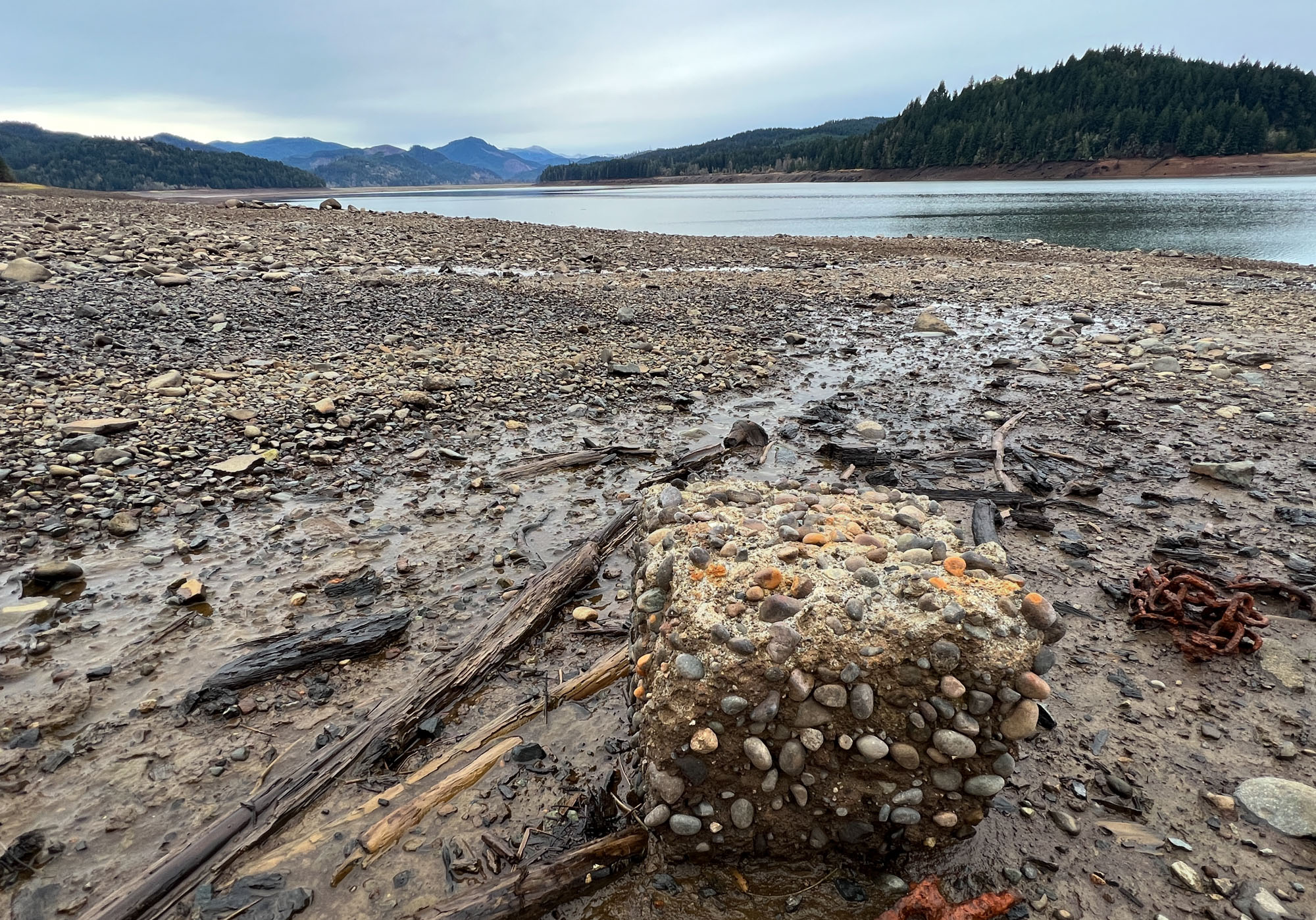

Not that you’re dying for photos of sidewalks, but all these pictures are freely available as uncropped version on my geology photo website. If you type “sidewk” into the search function (red button), they’ll appear and you can download a copy!

Oh! And I wrote an earlier (short) essay about the conglomerate at the base of the Kootenai Formation in Montana if you’re interested.

Levels of Time

This essay first appeared in the April, 2024 issue of Desert Report.

I’m hiking up a closed road in Death Valley National Park to see a pile of gravel.  I guess that’s one way to look at it. What some folks might view as a waste of precious time in this magnificent place I see as a vehicle for time travel.

Gravel ridge along the Beatty cut-off road in Death Valley was deposited as a spit near the shoreline of Glacial Lake Manly. The highway cuts right through the center of the spit. Two smaller spits are visible on the far right side of the image. (photo 240106-97)

Just 4 months ago in August, Hurricane Hilary dropped some 2.2 inches of rain on Death Valley—more than what typically falls here over the course of a year. With virtually no soil to absorb it, the water ran off immediately. It gathered in rivulets, confluenced into small channels, then larger channels, and finally streams that flash-flooded down canyons and alluvial fans. The flooding closed every road in the national park. It’s now early January, 2024 and this road up one of the fans isn’t supposed to open to cars for another two weeks.

In just under two miles, I reach my destination, a low ridge extending eastward from the base of a hill. It was deposited by waves near the shoreline of a giant lake called Glacial Lake Manly, sometime between186,000-120,000 years ago. The ridge grew by fits and starts out from the hill as a spit, with waves obliquely slapping its front and moving the gravel out to its tip. You can see wave-rounded cobbles in the roadcut forming curved layers that slope towards the valley. They’re also scattered about on the top of the spit where I sit down and take in the view.

The highway cuts right through the spit. Death Valley, once filled to a spot above and behind the spit, is in the background. (Photo 191101-75)

In front of me, the highway descends its gentle gradient to where I parked the car, nearly 200’ below sea level. From there, the floor of Death Valley is practically flat, continuing well past Badwater Basin some 25 miles to the south. When this gravel spit formed, Lake Manly, more than 50 miles in length and some 6-8 miles wide, filled the entire scene. At its high stand, I’d be below water because the lake’s highest shoreline reached another mile up the road. The gravel spit formed as the lake receded. Two smaller ridges lie just below where I sit and another very small one lies just above, marking different stages in its retreat.

Just like anybody, I wrestle with the ever-changing and fluid concept of time. Stopped highway traffic that delays my arrival by 15 minutes can seem interminable and I bemoan how quickly a year passes. I’ve heard countless people comment at how Badwater Basin is still flooded by water from Hurricane Hilary but when it all finally evaporates, we’ll probably describe the shallow lake as short-lived. This remnant of a giant lake that existed over 100,000 years ago takes my confusion to a new level. Was that a long time ago?

It seems so, but then I think of the mountains that enclosed the lake. They started rising some 3-3.5 million years ago—more than 20 times the age of the lake.  I’ve always considered the mountains to be young, even going so far as to tell park visitors that Death Valley’s present landscape was “only about 3 million years old”. Compared to their rocks, many of which are older than 500 million years, that’s true. Some of the rocks are well over a billion years old.

Those rocks tell stories –about how they formed and about what’s happened to them since. I pick a cobble up off the spit. It’s a beautiful maroon color and made of tiny grains of quartz all mushed together. I suspect it came from the Zabriskie Quartzite, a distinctive rock unit that forms prominent cliffs throughout the region. Its sand was deposited mostly in a shallow ocean and various coastal environments during the Cambrian Period, which lasted from 539-485 million years ago.

Overturned Anticline in Titus Canyon–the Zabriskie Quartzite forms the prominent red cliffs in the right-center of the photo. To the left (west) is overturned Cararra and Bonanza King Formations. At the canyon mouth, the rocks are nearly horizontal, yet upside down. (Photo SrD-10)

I’ve studied geology my entire adult life and I still find it incredible that I can hold, in my own hands, a piece of the Cambrian sea floor. Each of the millions of tiny sand grains that make up this rock originated from some still-older rock and were transported by streams to the Cambrian shoreline. There, they were probably kicked around by coastal waves until getting buried by layers of more sediment, followed by more sediment for who knows how long –until circulating groundwater cemented the compacted grains together as layers of rock. In the Death Valley region, there are more than 10,000 feet of sedimentary rock on top the Zabriskie Quartzite and at least another 10,000 feet of sedimentary rock below. Each bedding plane in that sequence of rock was once the Earth’s surface.

And so much has happened to them since! Besides today’s mountain-building, driven because the earth’s crust in the region is extending, they’ve all experienced an earlier period of mountain-building by crustal compression. At the mouth of Titus Canyon just 20 miles northwest of here, those events folded the rock to where the sequence is completely upside down. Elsewhere, the rocks were intruded by granitic magma, while others were carried to depths of 15 miles or more and partially melted. And now, as today’s mountains erode, they shed rocks of all ages and types and sizes into their canyons, which get washed out onto the alluvial fans during floods.

From my perch on the gravel spit, I’m just a few feet above the alluvial fan. It’s unmoving and silent. The road will reopen soon, and tourists will once again drive past this spot without a second thought. But the myriad channels and wild assortment of rocks of the fan speak to a process that never stops. It will flood again. I see the whole fan in motion, with gravel streaming over the road, tearing up the asphalt, eventually burying or eroding the gravel spit. Today, this year, my existence—they all seem to diminish into the infinitesimal. I close my eyes and start walking downhill, deeper into the lake.


This essay came about from researching my forthcoming book: Death Valley Rocks! Forty amazing geologic sites in America’s hottest National Park, to be published by Mountain Press. (Sept, 2024)

Each photo (and >5000 more) is available for free download from my photography site, geologypics.com –just type the description or stock number into the search.

In Transit

This little black pebble, now sitting on my desk, traveled a lot today. After picking it up beneath a cliff face in southwestern Montana, I carried it in my pocket for a few hours and then drove some 20 miles to this college dorm where I’m staying.  It’s the most this pebble has moved for millions of years. 

Some time ago–this morning, a week, a year, 10 years, 100 years—the pebble weathered out of a much larger rock and fell to the ground. Its worn, rounded edges tell me that before it became part of that larger rock, it traveled down a stream bed –and its size tells me that its source probably wasn’t too far away. As is typical of stream gravel, its movement was irregular, marked by short bursts of movements during floods separated by longer periods of rest on a gravel bar or in the channel itself. Somewhere along the line, the pebble became buried by more sediment, probably because the land subsided or the river channel switched to another position. Eventually, the pebble and the rest of its surrounding sediment turned into rock.

Read more…

Skill and Spirit: Teaching field geology on public lands


Something different here: an essay I wrote about teaching field geology on public lands– published under the same title in the March, 2021 issue of Desert Report with a few extra photos added (please click on the photos to see them larger). I guess I’m hopeful –even optimistic– that I’ll be able to teach field camp again this summer! 
******************

Six pairs of eyes stared blankly at me. Cows. Amazing how big those creatures are, especially when you’re sitting on the ground so I was grateful they hadn’t already tried to share my tiny bit of shade. I stood up, shouldered my pack, and walked into the bright sun.

Folded Triassic rocks of the Dinwoody Formation

I’m in southwestern Montana, teaching a field geology class. It’s public land, a place I bring my students year after year without fear of locked gates or fences.  Besides the great geology, we see awesome views in all directions, innumerable cacti, wildflowers, and sagebrush, occasional wildlife, and of course, cattle. But we come for the rocks: layer after layer, deposited as seafloor sediment, coastal dune, or river gravel over a period spanning some 300 million years. We’re in what’s called the Rocky Mountain Fold-Thrust Belt, where the layers show twists and turns you can’t imagine, and fault zones that caused mountains to rise long before the present landscape even began to form.

And because the area’s managed by the Bureau of Land Management, we can go pretty much anywhere and everywhere over this 3 or 4 square mile area, just like the cows. Each student creates a detailed geologic map. They identify the rocks, draw lines on their maps to show the boundaries between different rock units, and use their maps to interpret the geologic history. It’s difficult work and highly rewarding ‒ and most students complete the course with a new-found sense of confidence and competence.

Students and thrust faults in Triassic LImestone and shale

I spot some students on a nearby ridge and veer off the gravel road to meet them. The sagebrush near the road is high, but as the slope steepens, it gives way to grass and ledges. On cresting the ridge, I call out:

 “How’s it going?”

“Okay” one of the students replies. We look at each other stupidly. I have no idea who it is.

“Hope you’re having a good day!” I say cheerfully and walk on.

These students aren’t mine. They’re from one of the many other universities that come here to teach field geology skills. With so many students tramping over this landscape every summer, following existing paths to key outcrops or creating their own, breaking pieces off the bedrock so they can inspect fresh surfaces, I sometimes worry that we might love this place to death.

I feel a slight cooling breeze and sit down. In front of me, the rocks form a rounded arch shape ‒ a product of crustal compression that built mountains here some 80 million years ago. The frustration of chasing down the wrong students morphs into gratitude. I think of the many students who’ve told me, years later, how much they learned here and how much it shaped their careers. Many describe how blending physical exertion with their academic backgrounds led to a sense of discovery they’d never before experienced.

I watch a pickup truck approach the cows down on the road. It slows briefly to pass by and then continues up the gentle grade. Multiple use ‒ that’s the BLM mantra. Besides grazing and wandering geology students, this place is open to energy development, timber harvesting, and all sorts of recreation. By comparison, our impact is small ‒ and the geology here will outlive all of us, no matter how many cattle trails we follow, or create, or how many outcrops we hammer. I’m grateful for our freedom to wander, pursuing education anywhere and everywhere here, and to arrive anytime without having to fill out any kind of paperwork.

****************************

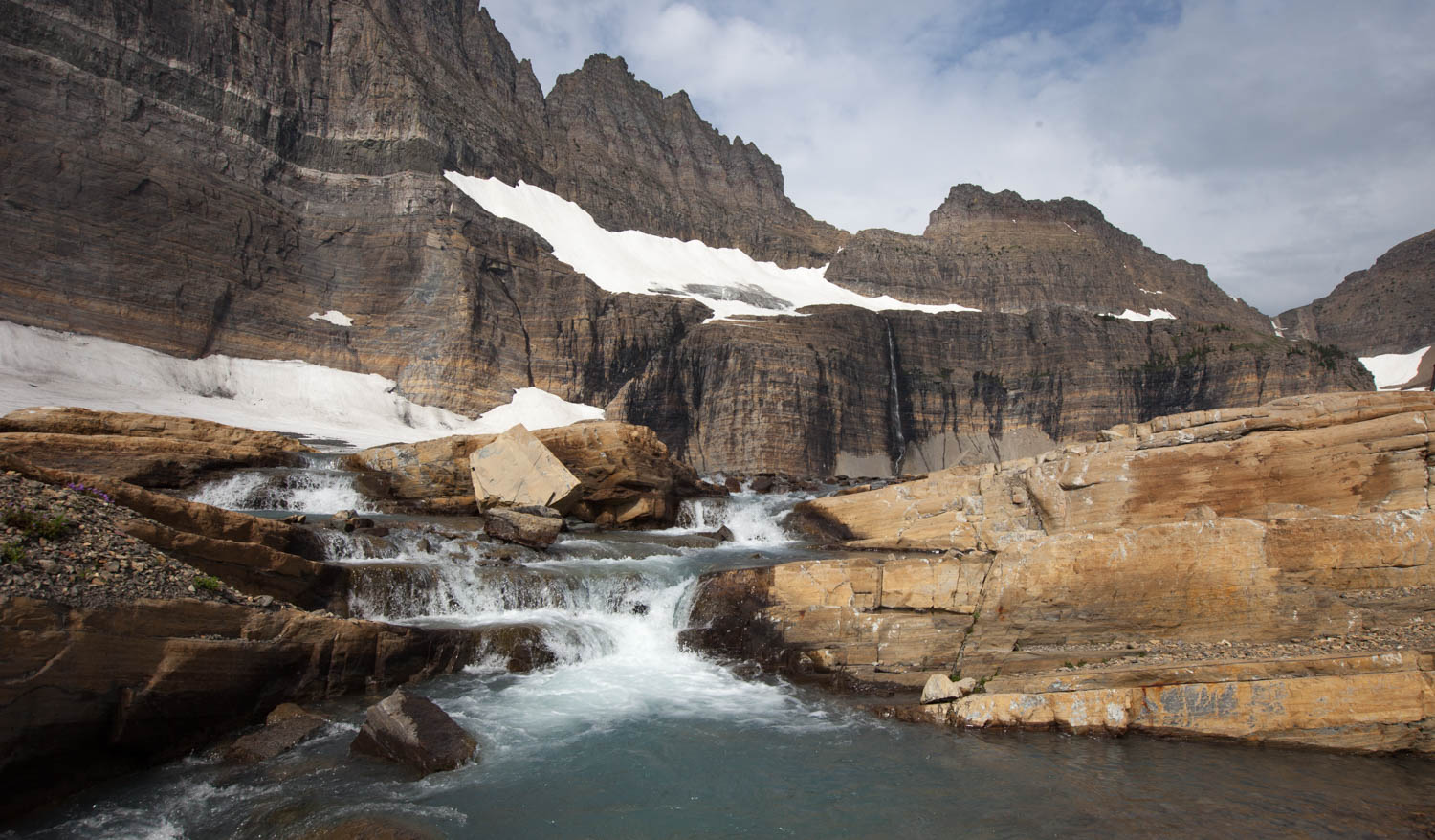
Ten days later, I’m sitting on a block of limestone, listening to water cascade over some ledges before coalescing into a narrow stream. Above me, soaring cliffs of Helena Dolomite form the headwall to the once mighty Grinnell Glacier. Some of the glacier persists high up in this cirque, but the retreat has been so rapid and recent that the glacial scratches across the bedrock are still fresh. Two of my students sit silently, gazing upwards to the headwall. Another studies a rock with a hand lens. Two others slowly make their way towards my perch.

Glacier National Park hosts a vast wilderness of landforms designated by glacial terminology: peaks called horns, ridges called arêtes, cliffs called headwalls, bowl-shaped valley heads called cirques, rock-bound lakes called tarns, deep U-shaped valleys called U-shaped valleys ‒ all carved by glaciers into this amazing bedrock. I ponder what this place must have looked like 15,000 years ago when glaciers were at their maximum. The peaks and some ridges would be recognizable but the valleys between them would be filled with ice that extended in long strands to the edge of the Great Plains.

One of my students practically shrieks with excitement. I’ve been waiting for this: they found the stromatolites, fossilized algae ‒ Earth’s oldest easily visible life form. Resembling an onion in cross-section, these thin concentric layers of rock formed when dome-shaped bodies of algae in shallow clear water trapped sediment as they grew. The ones here, which reach a meter or more in diameter, are the largest and most dramatic I’ve seen.

I watch the other students hurry over as the contemplative mood lights into a spontaneous revival. One student starts laughing. Another exclaims, “Look at this one!” another says, “Oh God!” another: “And the glacial striations go right across them!” Another turns to me quizzically: “How old are these rocks?”

I smile. “I just read that they were all deposited between 1.4 and 1.47 billion years old ‒ so somewhere in there.”

Another question: “And these glacial striations, maybe 10 or 15,000?”

I keep smiling. This spot is one of my all-time favorite places. We hiked the five miles up here for sunrise and now, mid-morning, still have the place to ourselves. The landscape is so fresh and raw ‒ so untouched ‒ that we feel a primeval kinship with this rock and ice.

I finally answer. “Or younger. This place was under ice just thirty years ago. There’s still some glacier left, just across the lake. So much change, huh?”

Many of my students have visited national parks before, but this is the first time they’ve come as geologists. They now see things through the lens of geologic time and process ‒ and for the first time, they are applying their knowledge to a landscape that not only surrounds them, but is beautiful and pristine. They learned important skills earlier in the course on BLM land and here they combine those skills with their human spirits.

We cross the stream and start picking our way up the ledges on the other side, finding more stromatolites as we go. I hear my students talking about landscape and time. Like me, they can relate to today’s landscape, and can imagine the scene during the glacial maximum some 15,000 years ago, but the shallow inland sea in which these rocks formed seems beyond comprehension. Its age, about 1.4 billion years, makes it all the more inconceivable. And what does the word “about” mean in this context anyway? If the rocks formed 1.41 instead of 1.40 billion years ago, they would be a full ten million years older. As geologists, we bandy these ages around with comfort, but when we really think about it, we can’t comprehend 10 million years, let alone a billion.

Upper Grinnell Lake and Helena Dolomite

I stop and consider a series of stromatolites in front of me. They’re exposed on both the front and upper sides of the ledge, giving three-dimensional views of their mounded shapes. Weathering and erosion rounded off many of the broken edges, accentuating the stromatolite’s appearance. For a second, I think I can see them breathe.

Our little group falls silent as we watch a rain squall farther down the valley. What a vast open-air cathedral we’re in! Public lands, be they national parks or forests or open BLM land, house these wonderful places and welcome everyone who will make the journey.


To see more geological photos from from SW Montana or Glacier NP, please see my geology photo website, where you can use keywords to search among >4000 images and download them for personal or instructional uses for free.

Post Navigation