geologictimepics

Geology and Geologic Time through Photographs

Archive for the tag “photography”

Granite

That’s actually the moon at the end of the crack in this rock…

granite and moon, Sierra Nevada, California.

A typical exposure of granite --coarse grained with an interlocking, random assortment of crystals. Click here to search for geology pictures by keyword.

And the rock is a pretty typical example of granodiorite… which is a lot like granite, except it has a little less silica.  See yesterday’s post about igneous rocks if you’re interested.

It turns out that most of the Sierra Nevada Range in California, including Mt. Whitney (the conterminous US’s highest peak) is made out of granodiorite.  And if you consider that most of the magma cooled and crystallized at a depth of 10km, and now resides about 4km ABOVE sea level, we’re looking at millions of years to accomplish this uplift.

Here’s Mt. Whitney at sunrise… It’s the peak just left-of center.  From this view, you can see that the rock of this part of the Sierra Nevada Range is all pretty much the same: granodiorite.

Mt. Whitney and Sierra Nevada, California at sunrise. Mt. Whitney's elevation is 14, 505' above sea level, the highest spot in the conterminous US. The rock in this photograph is almost entirely granodiorite.

Cambrian Limestone, Death Valley National Park, California.

Limestone’s a common sedimentary rock –it’s made from calcium carbonate.  The calcium carbonate is precipitated in shallow marine conditions with the help of biological activity, most commonly algae, but also by the many invertebrates that form shells.  This material then settles to the ocean bottom as a lime-rich mud and if the conditions are right, eventually becomes rock.

Compared with many other sedimentary rocks, limestone deposits can accumulate pretty rapidly –about 1 meter per thousand years in many cases –and even two or three times that under optimal circumstances.  These rates are for uncompacted sediment, and a great deal of compaction occurs as the sediment turns into rock.  Additionally, if the deposit is to accumulate to any significant thickness, the crust on which it is deposited must also subside.

Thousands of feet of limestone, deposited during the Cambrian Period, are exposed in the Death Valley region. Click here for a slideshow of Death Valley geology


So all this limestone in Death Valley was deposited as a bunch of horizontal layers in a shallow marine setting –not too deep, or light wouldn’t penetrate to the seafloor to allow photosynthesis –key to the ecosystem that produced the calcium carbonate in the first place.  And since it was deposited, it’s been uplifted and tilted and eroded.

It’s about time

It’s about time that I started a blog.  Geology and Geologic time are so visual–they lend themselves beautifully to photography.  And those are things that I feel very passionately about.  So that’s what I plan to do here… post the occasional photo of something geological and discuss geologic time.

Why is an understanding of geologic time important?  Briefly, it’s important because it gives us perspective on resources, environmental degradation, and perhaps most important, what it means to be human.  Resources form at geologic rates, but we humans use them at human rates.  Similarly, environmental degradation will eventually heal… at geologic rates –but we cause the degradation at human rates.  And with respect to our humanity?  Seems to me that to realize human beings have been around for only a tiny fraction of Earth History naturally gives us some humility –something we could all probably use.

I plan to take a visual approach to geologic time… through photographs.  There’s no need to discuss radiometric dating, because one doesn’t radiometric dating to show that the Earth is inconceivably old.  You only need to think about the processes involved in forming a geologic feature and an open mind.  Many of these photos come from my website: marlimillerphoto.com –you can download over a thousand geology images from there for free.

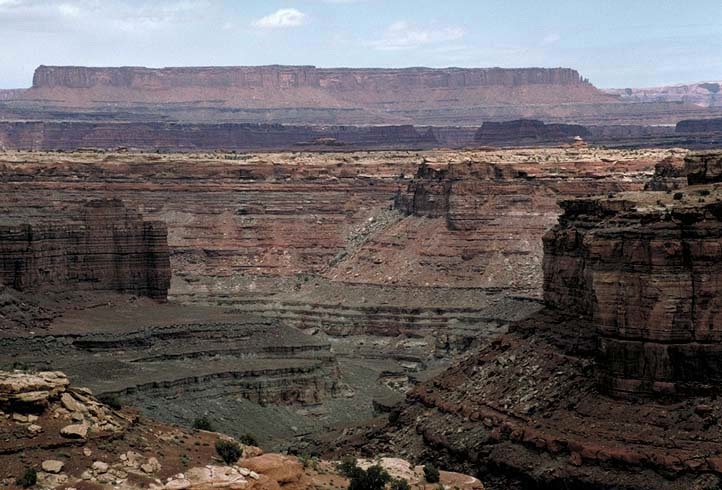
Thousands of feet of sedimentary rock, exposed in the canyons of SE Utah, attest to great lengths of geologic time. This particular canyon is in the Needles District of Canyonlands National Park.

So when you look down a canyon, like the one in this photo, you’re looking at unmistakeable evidence for great lengths of time… it’s not that the canyon itself took so long to form (maybe 100’s of thousands of years?  More?  Less?), but the rock itself, made of layer upon layer of sediment, deposited in different environments —That’s where we can get a glimpse of geologic time.

More later… thanks for looking!
–Marli

Post Navigation