geologictimepics

Geology and Geologic Time through Photographs

Archive for the tag “nature”

Levels of Time

This essay first appeared in the April, 2024 issue of Desert Report.

I’m hiking up a closed road in Death Valley National Park to see a pile of gravel.  I guess that’s one way to look at it. What some folks might view as a waste of precious time in this magnificent place I see as a vehicle for time travel.

Gravel ridge along the Beatty cut-off road in Death Valley was deposited as a spit near the shoreline of Glacial Lake Manly. The highway cuts right through the center of the spit. Two smaller spits are visible on the far right side of the image. (photo 240106-97)

Just 4 months ago in August, Hurricane Hilary dropped some 2.2 inches of rain on Death Valley—more than what typically falls here over the course of a year. With virtually no soil to absorb it, the water ran off immediately. It gathered in rivulets, confluenced into small channels, then larger channels, and finally streams that flash-flooded down canyons and alluvial fans. The flooding closed every road in the national park. It’s now early January, 2024 and this road up one of the fans isn’t supposed to open to cars for another two weeks.

In just under two miles, I reach my destination, a low ridge extending eastward from the base of a hill. It was deposited by waves near the shoreline of a giant lake called Glacial Lake Manly, sometime between186,000-120,000 years ago. The ridge grew by fits and starts out from the hill as a spit, with waves obliquely slapping its front and moving the gravel out to its tip. You can see wave-rounded cobbles in the roadcut forming curved layers that slope towards the valley. They’re also scattered about on the top of the spit where I sit down and take in the view.

The highway cuts right through the spit. Death Valley, once filled to a spot above and behind the spit, is in the background. (Photo 191101-75)

In front of me, the highway descends its gentle gradient to where I parked the car, nearly 200’ below sea level. From there, the floor of Death Valley is practically flat, continuing well past Badwater Basin some 25 miles to the south. When this gravel spit formed, Lake Manly, more than 50 miles in length and some 6-8 miles wide, filled the entire scene. At its high stand, I’d be below water because the lake’s highest shoreline reached another mile up the road. The gravel spit formed as the lake receded. Two smaller ridges lie just below where I sit and another very small one lies just above, marking different stages in its retreat.

Just like anybody, I wrestle with the ever-changing and fluid concept of time. Stopped highway traffic that delays my arrival by 15 minutes can seem interminable and I bemoan how quickly a year passes. I’ve heard countless people comment at how Badwater Basin is still flooded by water from Hurricane Hilary but when it all finally evaporates, we’ll probably describe the shallow lake as short-lived. This remnant of a giant lake that existed over 100,000 years ago takes my confusion to a new level. Was that a long time ago?

It seems so, but then I think of the mountains that enclosed the lake. They started rising some 3-3.5 million years ago—more than 20 times the age of the lake.  I’ve always considered the mountains to be young, even going so far as to tell park visitors that Death Valley’s present landscape was “only about 3 million years old”. Compared to their rocks, many of which are older than 500 million years, that’s true. Some of the rocks are well over a billion years old.

Those rocks tell stories –about how they formed and about what’s happened to them since. I pick a cobble up off the spit. It’s a beautiful maroon color and made of tiny grains of quartz all mushed together. I suspect it came from the Zabriskie Quartzite, a distinctive rock unit that forms prominent cliffs throughout the region. Its sand was deposited mostly in a shallow ocean and various coastal environments during the Cambrian Period, which lasted from 539-485 million years ago.

Overturned Anticline in Titus Canyon–the Zabriskie Quartzite forms the prominent red cliffs in the right-center of the photo. To the left (west) is overturned Cararra and Bonanza King Formations. At the canyon mouth, the rocks are nearly horizontal, yet upside down. (Photo SrD-10)

I’ve studied geology my entire adult life and I still find it incredible that I can hold, in my own hands, a piece of the Cambrian sea floor. Each of the millions of tiny sand grains that make up this rock originated from some still-older rock and were transported by streams to the Cambrian shoreline. There, they were probably kicked around by coastal waves until getting buried by layers of more sediment, followed by more sediment for who knows how long –until circulating groundwater cemented the compacted grains together as layers of rock. In the Death Valley region, there are more than 10,000 feet of sedimentary rock on top the Zabriskie Quartzite and at least another 10,000 feet of sedimentary rock below. Each bedding plane in that sequence of rock was once the Earth’s surface.

And so much has happened to them since! Besides today’s mountain-building, driven because the earth’s crust in the region is extending, they’ve all experienced an earlier period of mountain-building by crustal compression. At the mouth of Titus Canyon just 20 miles northwest of here, those events folded the rock to where the sequence is completely upside down. Elsewhere, the rocks were intruded by granitic magma, while others were carried to depths of 15 miles or more and partially melted. And now, as today’s mountains erode, they shed rocks of all ages and types and sizes into their canyons, which get washed out onto the alluvial fans during floods.

From my perch on the gravel spit, I’m just a few feet above the alluvial fan. It’s unmoving and silent. The road will reopen soon, and tourists will once again drive past this spot without a second thought. But the myriad channels and wild assortment of rocks of the fan speak to a process that never stops. It will flood again. I see the whole fan in motion, with gravel streaming over the road, tearing up the asphalt, eventually burying or eroding the gravel spit. Today, this year, my existence—they all seem to diminish into the infinitesimal. I close my eyes and start walking downhill, deeper into the lake.


This essay came about from researching my forthcoming book: Death Valley Rocks! Forty amazing geologic sites in America’s hottest National Park, to be published by Mountain Press. (Sept, 2024)

Each photo (and >5000 more) is available for free download from my photography site, geologypics.com –just type the description or stock number into the search.

Iceland –where you can walk a mid-Atlantic rift –and some other geology photos

While Iceland hosts an amazing variety of awesome landscapes, what stands out to me most are its incredible exposures of the Mid-Atlantic ridge. To the north and south, the ridge lies beneath some 2500m of water, forming a rift that separates the North American plate from the Eurasian plate. The rift spreads apart at a rate of some 2.5 cm/year, forming new oceanic lithosphere in the process. But in Iceland, you can actually walk around in it!

Please click on any of the images below to see them enlarged.

Iceland2geomapplates

Geologic map of Iceland as compiled from references listed below.

Read more…

Sampling New Zealand’s (Amazing) Geology

New Zealand’s landscape can make just about anybody appreciate geology. Its glaciated peaks, its coastline –that ranges from ragged cliffs to sandy beaches to glacial fjords– its active volcanoes… they all work together to shout “Earth Science!” With that in mind, here’s some basics of New Zealand’s amazing geology, followed by some geological highlights of my trip of January and early February, 2018.

NZ map--all

Map of New Zealand, showing accreted terranes in colors and cover assemblage in gray. (Compiled mostly from Graham, 2015)

North and South Island Bedrock  The different colors on this map show New Zealand’s basement rock, named so because it forms the lowest known bedrock foundation of any given area. The basement tells stories of New Zealand’s deep past, from about 500-100 million years ago. Individual colors signify different terranes, accreted (added) one-by-one through plate motions to the edge of what was then the supercontinent Gondwana. They mostly consist of sedimentary and metamorphosed sedimentary rock, although the narrow belt of purple-colored Dun Mountain Ophiolite formed as oceanic lithosphere, and the red-colored areas consist of granitic igneous rock, some of which has been metamorphosed to gneiss.

Gray indicates the younger cover rock, formed after accretion of the terranes. Consisting of a wide range of sedimentary and volcanic rocks, as well as recently deposited sediment, it’s just as interesting and variable as the terranes. Because it includes volcanoes, it’s largely the cover that gives the North Island its distinctive flair. By contrast, the South Island consists largely of uplifted basement rock, much of which has been –and still is—glaciated. All those long deep lakes, such as Lakes Wanaka and Tekapo, were carved by glaciers and are now floored with their deposits of till.

Andesite stratovolcano, New Zealand

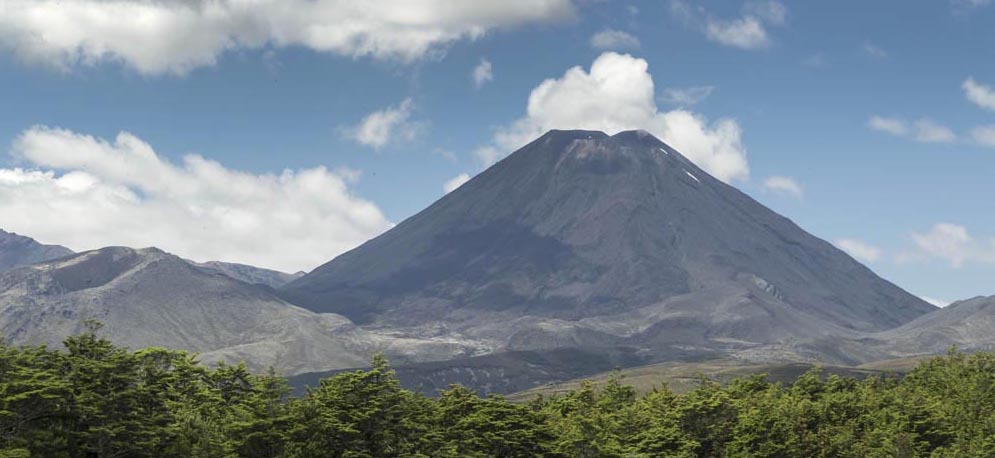
Mt. Ngauruhoe, a 7000 year-old andesite stratocone near Ruapehu on the North Island

Those differences exist largely because the North and South Islands occupy different plate tectonic settings. The North Island sits over a subduction zone, so it hosts an active Read more…

Mauna Loa Volcano, Hawai’i –Earth’s largest active volcano

To get an idea of the immensity of Mauna Loa Volcano, take a look at the photo below. That rounded shape continues from its summit area at 13,678 feet above sea level to about 18,000 feet below sea level –and then another 25,000 feet or so below that because the mountain has sunk into the oceanic crust. It’s unquestionably the world’s largest active volcano.

Mauna Loa Shield Volcano

Profile of Mauna Loa Shield Volcano from… Mauna Loa Shield Volcano! (Geologypics: (170919s-15))

Briefly, Mauna Loa’s made of basalt. Basaltic lava flows, being comparatively low in silica, have low viscosities and so cannot maintain steep slopes, resulting in broad, relatively low gradient volcanoes called shields. With just a little imagination, you can see how Mauna Loa’s shape resembles that back side of some shield one of King Arthur’s Knights might carry into battle.

Read more…

Geologypics.com– A new (and free) resource for geological photographs

What better way to kick off my new website than to write about it on my blog? To see it, you just need to click on the word “home” in the space above. Or you can click the link: geologypics.com.

Here’s part of the front page:
home3

As it says, the site offers free downloads for instructors –and for anybody who’s craving a good geology photograph. It’s my way of contributing to geology education –showing off some of our landscape’s amazing stories and providing resources for other folks who want to do the same.

I think the best part of the whole site is that red button in the middle of the home page. It says “Image Search by Keyword”.

Right now, there are more than 2200 images you can search for — all of which are downloadable at resolutions that generally work for powerpoint. If you search for “sea stack” for example, you’ll get 38 hits –and the page will look like this:

Sea Stack search

First page of sea stacks when you search on the term.


Notice that ALL the photos are presented as squares–which works for most photos, but not all. To help mitigate that, the photos with vertical or panorama formats say so in their title, so you know to click on them to see the whole image. Take the photo in the upper center, for example –it’s got a  vertical format. Here it is:vertial image


A more detailed caption below the photo, along with its ID number appears at the bottom of the pic. This particular image is the chapter opener to the Coast Range in my new book “Roadside Geology of Washington“, which I wrote with Darrel Cowan of University of Washington.

There are also galleries –a chance to browse a variety of images without having to think of keywords. Similar to the search, they’re presented as squares so you need to click on the photo to see the whole thing.


Here’s what the photo gallery page looks like (on the left), followed by part of the “glaciation” page you’d see if you clicked on “glaciation”.  Woohoo!

galleries

part of Galleries page (left) and part of Glacial page (right)


Then there’s the “About” page, which gives some information about me and details my policies regarding use of the images (basically, you can download freely for your personal, non-commercial use if you give me credit; if you want to use the image in a commercial publication you need to contact me to negotiate fees). There’s also a “News” page, that gives updates on the website. There’s a contact page from which you can send me emails. And the blog? It goes right back to here!

And finally, if you’re looking for a great web designer? Try Kathleen Istudor at Wildwood SEO –she created the site and spent hours coaching me on how to manage it.

Enjoy the site!


Summarizing Washington State’s Geology –in 19 photo out-takes

Washington State displays such an incredible array of geologic processes and features that it makes me gasp –which is one reason why writing “Roadside Geology of Washington” was such a wonderful experience. I also got to do it with my long-time friend and colleague (and former thesis advisor at the University of Washington) Darrel Cowan. The book should be on bookshelves in mid-September –and I can’t think of a better way to celebrate than by summarizing Washington’s amazing geology with a bunch of out-take photos –ones that didn’t made it into the book or even to my editor. Like the photo below:

Mount Baker, Washington (150916-4)

Mt. Baker, a glaciated stratovolcano in northern Washington State.

Mount Baker’s a stratovolcano that erupted its way through the metamorphic rock of the North Cascades. I took the photo from the parking lot at a spot called Artist’s Point –at the end of WA 542 –and my editor nixed it because I already had enough snow-capped volcanoes in the book.

On the cross-section below–which includes elements of Oregon as well as Washington, Mt. Baker is represented by the pink volcano-shaped thing labelled “High Cascades”. The following 15 or so photos illustrate most of the other features on the cross-section –so together, they illustrate much of the geology and geologic history of the state!

Cross-section across PNW

Generalized cross-section across Washington and Oregon.

Washington State and geologic provinces

Washington State and geologic provinces.

A quick note about organization: I’m separating the images according to their  physiographic province. There are six in Washington: Coast Range, Puget Lowland, North Cascades, South Cascades, Okanogan Highlands, and Columbia Basin.


Coast Range:
As you can see in the cross-section, the Coast Range borders the Cascadia Subduction Zone and consists of three main elements: the Hoh Accretion Assemblage in yellow, Siletzia (called the “Crescent Formation” in Washington) in purple, and the post-accretion sedimentary rock in brown. Siletzia is the oldest. It was thrust over the Hoh Accretion Assemblage, which is still being accreted at the subduction zone. The post-Accretion sedimentary rocks were deposited over the top of Siletzia after it was accreted about 50 million years ago.

And here are some photos! Siletzia formed as an oceanic plateau and so is characterized Read more…

Oregon’s rocky headlands: geologic recycling through erosion and uplift and erosion…

160227-24t

Crashing waves at Heceta Head, Oregon

You can’t avoid thinking about erosion while standing on one of Oregon’s rocky headlands. The waves keep coming, one after another, each crashing repeatedly against the same rock. Impossibly, the rock appears unmoved and unchanged. How can it not erode?

The answer, of course, is that headlands do erode, quickly, but on a geologic time scale. We just miss out because we live on the much shorter human time scale. And the erosion belongs to a cycle in which coastal uplift causes eroded and flattened headlands to rise and become headlands once again, all subject to more ongoing erosion and uplift.

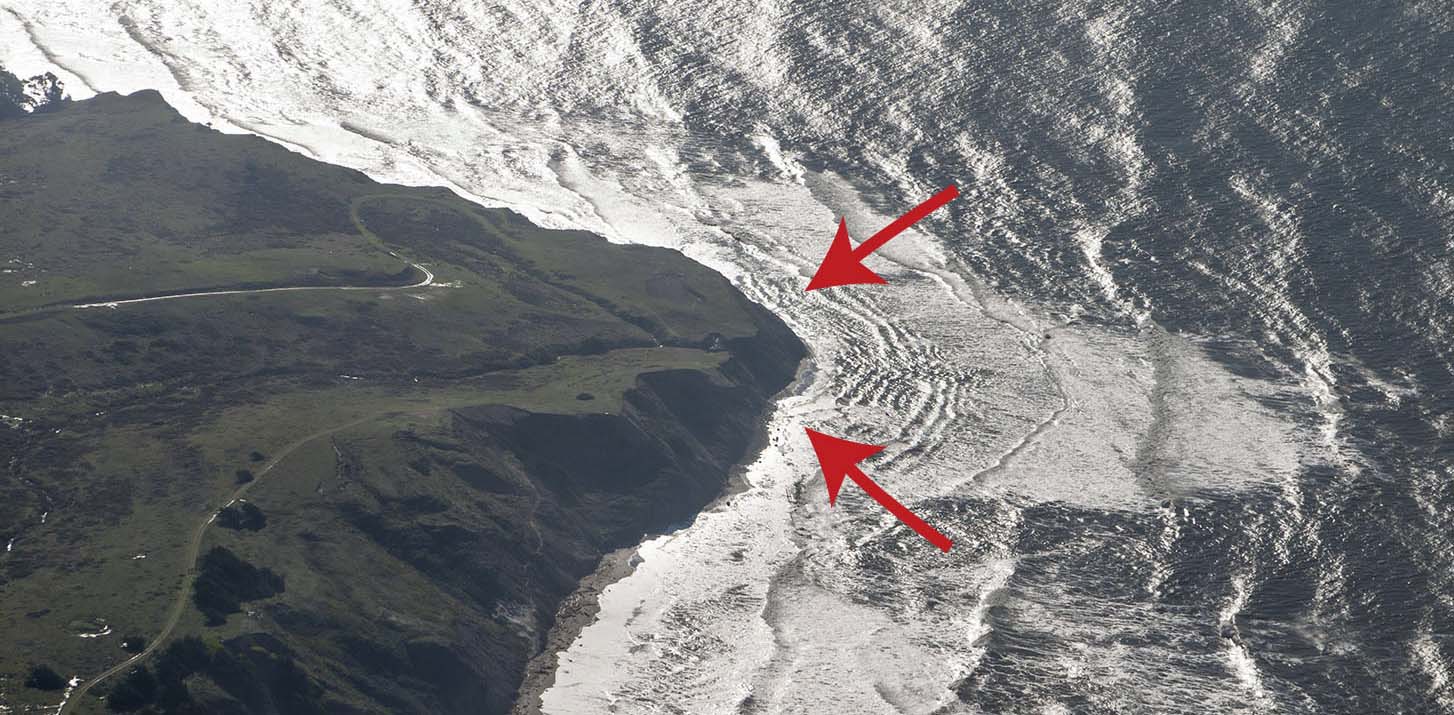
Wave energy is most intense at headlands because the incoming wave typically feels the ocean bottom near the headland first, which causes the wave to refract. As shown in the aerial photo below, this refraction focuses the wave energy on the headland.

CE-06060115-33-arrowsc

Wave refraction causes wave energy to focus on the headland. Arrows are perpendicular to wave fronts.

As you can see in the next few images, headlands don’t erode evenly. They erode irregularly, as the waves exploit any kind of weakness in the rocks such as faults and fractures, or if they’re sedimentary, bedding surfaces. The products of this erosion are as beautiful as they are interesting: sea stacks, sea arches, sea caves… The list goes on and on.

Headland and lighthouse, Heceta Head, Oregon

Aerial view of Heceta Head, Oregon.

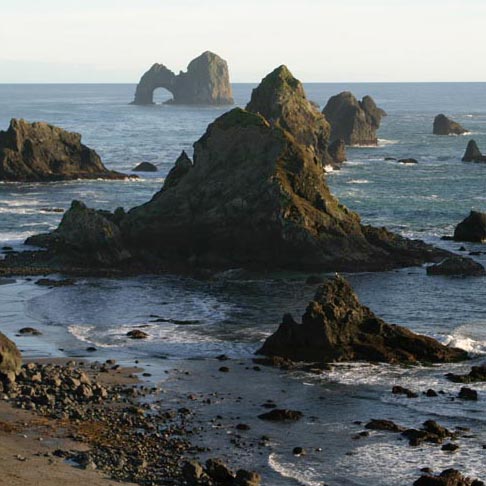
From the above photo, you can see that sea stacks are simply the leftover remains of a headland as it retreats from erosion. That’s a critical point, because some sea stacks, especially the one with the arch in the photo below, are a long way from today’s coastline.

Sea stacks and sea arch, southern Oregon

Sea stacks and sea arch, southern Oregon

Those rocks, 1/4 to a 1/2 mile away used to be a part of the coastline? The land used to be way out there? YES!!! For me, that’s one of the very coolest things about sea stacks –they so demonstrate the constant change taking place through erosion.

Taken to its extreme, erosion renders headlands into wave-cut platforms, such as the one below at Sunset Bay. Being in the intertidal zone, these platforms make great places for tide-pooling–and ironically, for people-watching too. Geologically, they form important markers because they’re both flat and form at sea level. When found at higher elevations, they indicate uplift.

Wave-cut bench, Sunset Bay, Oregon

Wave-cut bench at Sunset Bay, Oregon

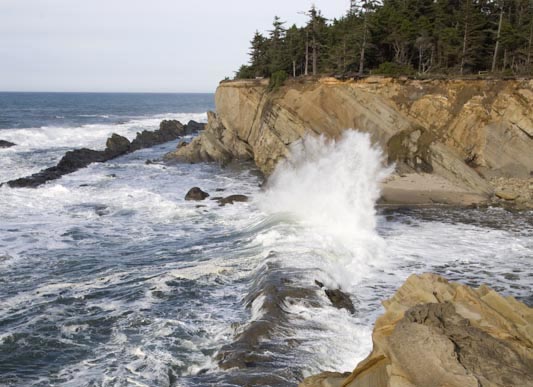
In fact, looking carefully at the photo above, you can see a flat surface on the other side of the bay. It’s an uplifted wave-cut platform! Called a marine terrace, it’s covered by gravel and sand originally deposited in the intertidal zone. Those deposits rest on bedrock that, at an earlier time, was also flattened by the waves. The photo below shows a better view of this terrace from the other side.

5D-8922clr

Breaking wave at Shore Acres State Park, Oregon. Tree-covered flat surface in the background is an uplifted marine terrace.

These uplifted marine terraces can be found up and down Oregon’s coastline. Researchers recognize several different levels, the oldest being those uplifted to highest elevations. The one in the photo above at Shore Acres State Park is called the Whiskey Run Terrace and formed about 80,000 years ago. You can see a similar-aged terrace below as the flat surface beneath the lighthouse at Cape Blanco, Oregon’s westernmost point. An older, higher terrace forms the grass-covered flat area on the right side of the photo.

Cape Blanco, Oregon

Cape Blanco, Oregon looking NE. The flat surface beneath the lighthouse is the ~80,000 year-old Cape Blanco Terrace, probably equivalent to the Whiskey Run Terrace at Shore Acres; the flat area on the right side of the photo is the higher Pioneer Terrace,  formed ~105,000 years ago.

Researchers take the approximate ages of the terraces and their elevations to calculate approximate rates of uplift. In this area, Kelsey (1990) estimated a rate of between 4-12 inches of uplift every 1000 years. That might seem slow, but over hundreds of thousands of years, it can accomplish a great deal.

And look! The uplifted terraces? They’re on headlands! Of course, because they’ve been uplifted! And the headlands are now eroding into sea stacks and then platforms –to be uplifted in the future and preserved as marine terraces that sit on top headlands. And on and on, as long as the coastline continues rising.

YachatsWaves1-4

Blowhole near Yachats, Oregon. Incoming wave funnels up a channel eroded along a fracture and explodes upwards on reaching the end.

Some links and references:
Kelsey, H.M., 1990, Late Quaternary deformation of marine terraces of the Cascadia Subduction Zone near Cape Blanco, Oregon: Tectonics, v. 9, p. 983-1014. (Detailed study of Cape Blanco, including uplift rates).

Miller, M., 2014, Roadside Geology of Oregon, Mountain Press, Missoula, 386p. (General reference which details the concepts and includes several of the photos used here).

Earth Science Photographs: free downloads for Instructors —or anybody! (my webpage)

Scientists, Science, Icicles, and Faith

In January, I started teaching the Introductory Geology course “Environmental Geology and Landform Development” –with two lecture sections of about 200 students each. And this course, populated largely by folks who are fulfilling a science requirement and  otherwise try to avoid science like it was the plague, needed some general statement about science. After all, it’s science that may someday save them from the plague!

So science… what is it? Seems like scientists themselves have a zillion different definitions, so I started with “Scientist. –What’s a scientist?” If you google “scientist” and then look at the images, you see this. As this image is a screenshot of photos that aren’t mine, I intentionally blurred it, but you should get the idea of what’s there.

lec1-allrb

Really??? these are the most popular images of scientists and in every picture–save the tiny one in the lower right– is some person in a WHITE LAB COAT and a microscope or a beaker. Ironically, it shows about 50% of the scientists as women. Go figure there too.

Looks like we’ve been fed a misrepresentation of what scientists are. We actually do a wide variety of things. In geology, we do a wide wide range of things. We spend time in the field (see picture below), we write, we draw maps and cross-sections, we look down microscopes (maybe in jeans and t-shirts), we write computer models, we do experiments, and we sometimes wear white lab coats.

130324-17c

Geologist inspecting a fault zone between the dark-colored Beck Spring Dolomite and the overlying light-brown Noonday Dolomite. Death Valley, California.

All the time, we’re trying to understand something about our world. Our universe. We’re collecting information (data). We’re testing ideas. We’re adding detail to somebody else’s ideas. We’re building a framework of knowledge that’s grounded in our observations and testable ideas. Replace the word “ideas” with “hypotheses” in this paragraph –and you get science.

Ideally, most scientists approach their work using the “scientific method” –which is a highfalutin way of saying they see something they don’t understand (an observation), which causes them to ask a question (like how did this happen?); they come up with ideas (hypotheses) that may explain it, and then they test those hypotheses.

ice-stufflr

Icicles?

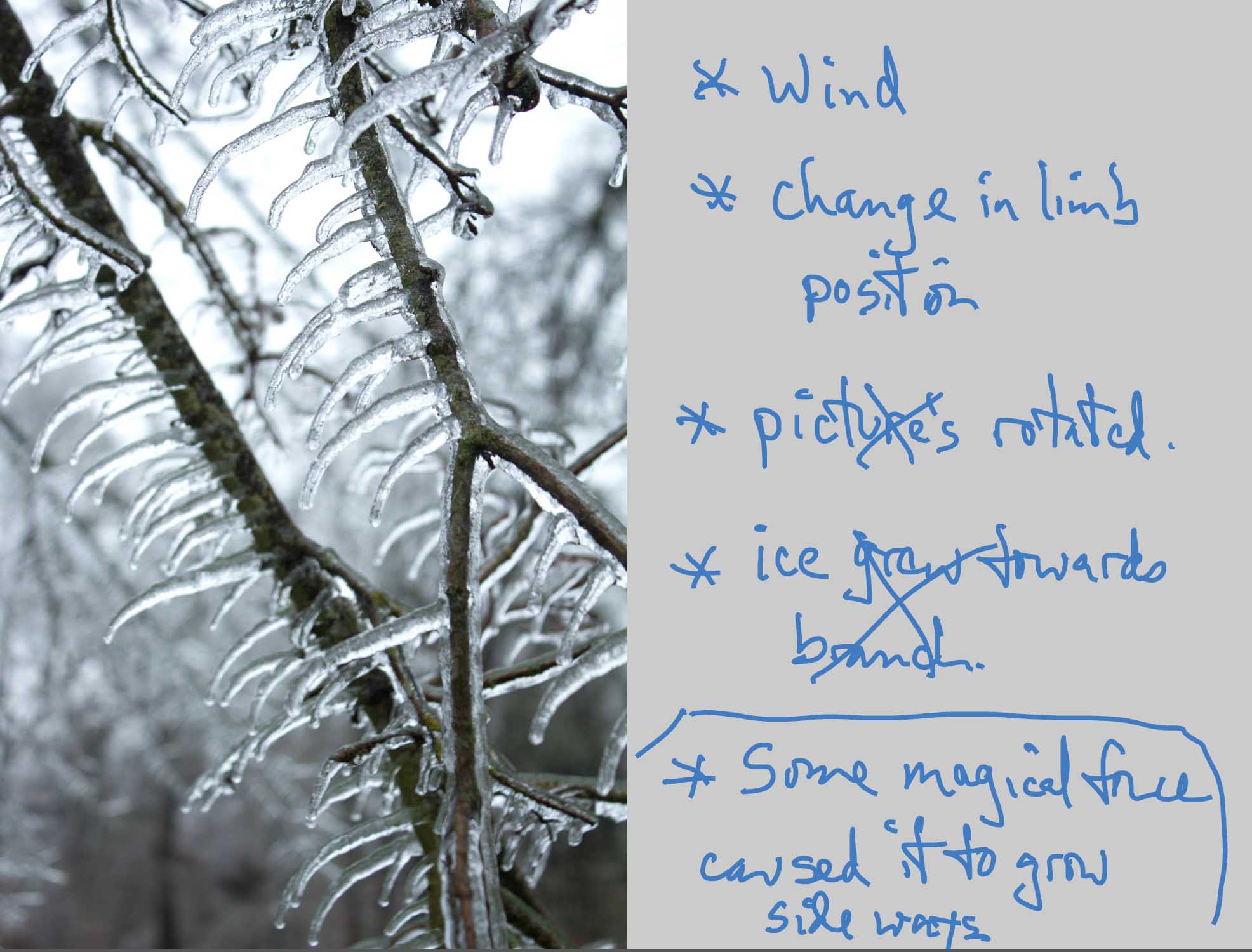
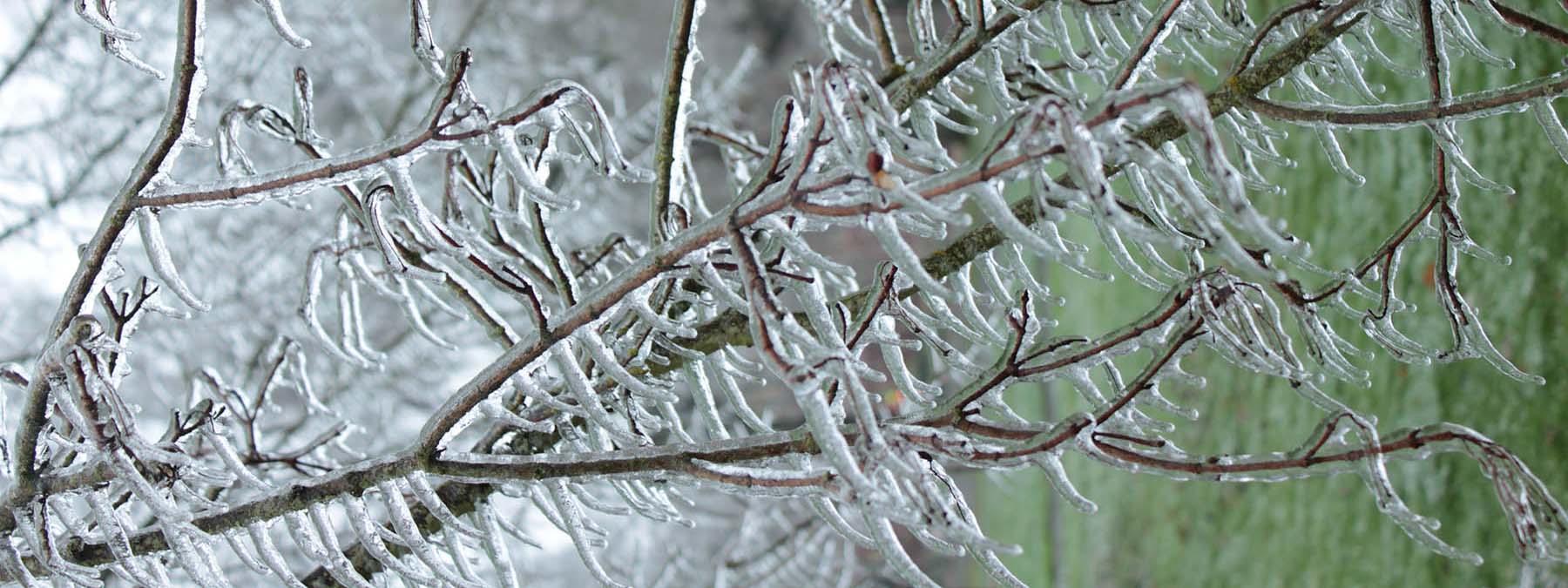
Which is what we did in class with icicles! The month before–in mid-December–Eugene had this incredible ice storm, which covered everything in ice to make it look like a scene from the movie Frozen. It was beautiful and destructive. And we can all pretty much guess how icicles form: water starts to drip off the branch but freezes before it falls off. Icicles grow straight downward off the branch because water, like everything else, falls vertically with gravity.

As it turned out, some of the icicles seemed to grow straight out from the branches. Look at the photo below! How could this be? We know icicles should grow straight downwards! So as a group, we came up with some hypotheses, shown below next to the picture. I was the proud sponsor of hypothesis #4 and #5.

lec1-c

Alternate hypotheses to explain near horizontal growth of icicles

As a group (all 200 of us), we could rule out hypothesis #3, that the picture was rotated. I shot the image and promised I didn’t rotate it! We could also rule out hypothesis #4, that the ice somehow grew horizontally towards the branch, because that idea conflicted with all previous observations we’d made on icicles, that they grow away from the branch as ice progressively freezes.

That left hypotheses #1, #2, #5. We figured ways we could test #1, #2. If it were the wind, for example, we’d expect all the icicles to go in one direction in a given place, regardless of the limb angle. If it were #2, we might expect to see some icicles show a curve to indicate progressive tilting of the branch–which you can actually see in the photo above!

Hypothesis #5, that “Some magical force caused it to grow sideways”isn’t testable. It’s NOT TESTABLE. We can’t come up with ways to support it or rule it out. You can believe it if you want to, but it’s not science.

That’s the point. To be scientific, a hypothesis must be testable. Most of us hold various non-scientific beliefs in our hearts that we know to be true –for us. I think that’s a good thing. For many of us, those beliefs lend us qualities like strength or courage or compassion when we need them the most. They’re still not scientific.

And that’s what really gripes me about the “scientific creationists” –as well as today’s Republican Party. The “scientific creationists” say they use science to demonstrate the existence of God, or that Earth is young –when believing either requires a suspension of science and an act of Faith. By claiming they’re being scientific, the “scientific creationists” hamstring their own belief system. They take the wonder out of religion and render it baseless and sterile.

And the Republicans? They’re now all about “alternative facts”. Maybe it’s unfair to group “all Republicans” together –but I see very few standing up to this reckless leader we have. Maybe they just lack integrity.

161215-7lrcrot

this photo was rotated

Landscape and Rock–4 favorite photos from 2015

Landscape and bedrock… seems we seldom connect the two. We all like beautiful landscapes, but most of us don’t ask how they formed –and even fewer of us think about the story told by the rocks that lie beneath it all. Those make two time scales, the faster one of landscape evolution and the much slower one of the rock record. Considering that we live in our present-day human time scale, it’s no wonder there’s a disconnect!

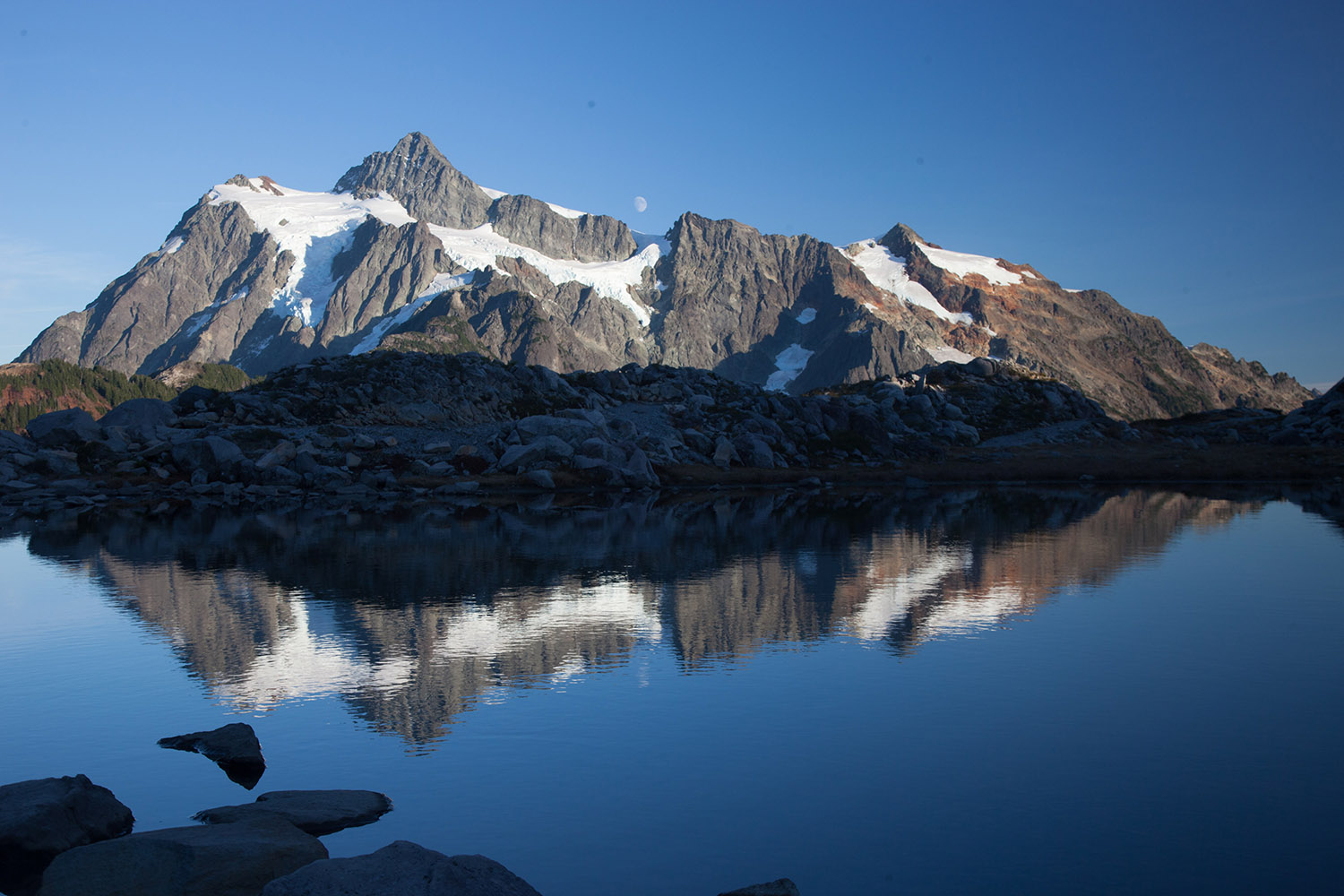
Take this photo of Mt. Shuksan in northern Washington. My daughter Meg and I drove up to the parking lot at Heather Meadows and went for a quick hike to stretch our legs and take some pictures just before sunset.We had about a half hour before the light faded –and all I could think about was taking a photo of this amazing mountain. But the geology? What??

151023-22

1. Mt. Shuksan and moonrise, northern Washington Cascades.

Thankfully, I’d been there in September scoping out a possible field project with a new grad student, and had the time to reflect… on time. From the ridge we hiked, shown as the dark area in the lower left corner of the left-hand photo below, we could almost feel Shuksan’s glaciers sculpting the mountain into its present shape. Certainly, that process is imperceptibly slow by human standards.

Shuksan combo

Mt. Shuksan: its glaciated NW side, summit, and outcrop of the Bell Pass Melange.

But the glaciers are sculpting bedrock –and that bedrock reveals its own story, grounded in a much longer time scale.

It turns out that the rock of Mt. Shuksan formed over tens of millions of years on three separate fragments of Earth’s lithosphere, called terranes. These terranes came together along faults that were then accreted to North America sometime during the Cretaceous. At the top of the peak you can find rock of the Easton Terrane. The Easton Terrane contains blueschist, a metamorphic rock that forms under conditions of high pressures and relatively low temperatures, such as deep in a subduction zone. Below that lies the Bell Pass Melange (right photo) –unmetamorphosed rock that is wonderfully messed up. And below that lies volcanic and sedimentary rock of the Chilliwack Group.

Here’s another of my favorites from 2015: the Keystone Thrust! It’s an easy picture to take –you just need to fly into the Las Vegas airport from the north or south, and you fly right over it. It’s the contact between the gray ledgey (ledgy? ledgeee?) rock on the left and the tan cliffs that go up the middle of the photo.

150427-57

2. Keystone Thrust fault, Nevada–gray Cambrian ridges over tan Jurassic cliffs.

The gray rock is part of the Cambrian Bonanza King Formation, which is mostly limestone, and the tan cliffs consist of  Jurassic Aztec Sandstone. Cambrian, being the time period from about 540-485 million years, is a lot older than the Jurassic, which spanned the time 200-145 million years ago. Older rock over younger rock like that requires a thrust fault.

Talk about geologic history… the thrust fault formed during a period of mountain building during the Cretaceous Period, some 100-70 million years ago, long before the present mountains. And the rocks? The limestone formed in a shallow marine environment and the sandstone in a sand “sea” of the same scale as today’s Sahara Desert. We know it was that large because the Aztec Sandstone is the same rock as the Navajo Sandstone in Zion and Arches national parks.

Cambrian-Jurassic

left: Limestone of the Cambrian Bonanza King Formation near Death Valley; right: Cross-bedded sandstone of the Jurassic Navajo Sandstone in Zion NP, Utah.

So… the photo shows cliffs and ledges made of rocks that tell a story of different landscapes that spans 100s of millions of years. But today’s cliffs and ledges are young, having formed by erosion of the much older rock.  Then I flew over it in about 30 seconds.

At Beach 2 near Shi Shi Beach in Washington State are some incredible sea stacks, left standing (temporarily) as the sea erodes the headlands. The sea stack and arch in the photo below illustrates the continuous nature of this erosion. Once the arch fails, the seaward side of the headland will be isolated as another sea stack, larger, but really no different than the sea stack to its left. And so it goes.

150912-42F

3. Sea arch and headland at Beach 2, Olympic Coast, Washington.

And of course, the headland’s made of rock that tells its own story –of  deposition offshore and getting scrunched up while getting added to the edge of the continent.

ShiShi

Bedrock at Beach 2 consists mostly of sandstone and breccia. The white fragment is limestone mixed with sandstone fragments.

And finally, my last “favorite”. It’s of an unnamed glacial valley in SE Alaska. My daughter and I flew by it in a small plane en route to Haines, Alaska to visit my cousin and his wife. More amazing landscape–carved by glaciers a long time ago. But as you can expect, the rock that makes it up is even older and tells it’s own story.

150616-119

4. Glacial Valley cutting into Chilkat Mountains, SE Alaska.

Of course, this message of three time scales, the human, the landscape, and the rock-record time scale applies everywhere we go. Ironically, we’re usually in a hurry. I wish I kept it in mind more often, as it might slow me down a little.

Here’s to 2015 –and to 2016.

To see or download these four images at higher resolutions, please visit my webpage: favorite 10 geology photos of 2015.


Conglomerate!

A trip to Death Valley over Thanksgiving two weeks ago reignited all sorts of things in my brain, one of which being my love of conglomerate. Honestly, conglomerate HAS to be the coolest rock!

151128-3

Tilted conglomerate in Furnace Creek Wash, Death Valley.

Just look at this stuff! Just like any good clastic sedimentary rock, it consists of particles of older rock–but with conglomerate, you can easily see those particles. Each of those particles opens a different door to experiencing deep geologic time.

As an example, look at the conglomerate below, from the Kootenai Formation of SW Montana. It contains many different cobbles of light gray and dark gray quartzite and pebbles of black chert. The quartzite came the Quadrant Formation and chert from the Phosphoria Formation. So just at first glance, you can see that this conglomerate in the Kootenai contains actual pieces of two other older rock units.

3528-38lr

Conglomerate of the Kootenai Formation, SW Montana.

But consider this: The Quadrant formed as coastal sand dunes during the Pennsylvanian Period, between about 320-300 million years ago and the Phosphoria chert accumulated in a deep marine environment during the Permian, from about 300-250 million years ago. The Kootenai formed as river deposits during the early part of the Cretaceous Period, about 120 million years ago. All those are now together as one.

Similar to the modern river below (except for the glaciers), the Kootenai rivers transported gravel away from highlands –the highlands being made of much older rock that was uplifted and exposed to erosion. That older rock speaks to long gone periods of Earth history while the gravel speaks to the day it’s deposited.

120709-123

Athabasca River in Jasper National Park, Alberta

But this is where my head starts to spin: the modern gravel is made of rounded fragments of old rock –so when you look at a conglomerate, you glimpse at least two time periods at once: you see the conglomerate, which reflects a river or alluvial fan –or any environment near a bedrock source– and you also see the particles, which formed in even older environments.

And it gets worse –or better. What happens when you see a conglomerate eroding? The conglomerate is breaking up into modern sediment, which consists of pieces of older sediment –that at one time was modern sediment that used to be older sediment?  Look at the pebbles below. I keep them in a rusty metal camping cup on a table in my office.

151209-4

“Recycled” pebbles of the Kootenai Formation.

These stream pebbles eroded out of the Kootenai conglomerate. So… they’re simultaneously modern stream pebbles and ancient ones –AND… they originated as the Quadrant and Phosphoria Formations. Four periods of time, spanning 300 million years, all come together at once.

And if that’s not enough, those conglomerates in Death Valley? They  contain particles of… conglomerate! Look! The arrow in the left photo points to the boulder of conglomerate on the right. If you click on the photos, you can see them enlarged.

All those particles, which are now eroding and becoming modern sediment, were yesterday’s sediment. And the conglomerate boulder? It too is becoming “modern sediment” and it too was “yesterday’s sediment” when it was deposited on an alluvial fan with the rest of the material. However, it goes a step further: its pebbles and cobbles were both “modern” and “yesterday’s” sediment at a still older time. And before that? Those pebbles and cobbles eroded from even older rock units, some of which date from the Cambrian, about 500 million years ago.

For fun, here’s a photo of another conglomerate boulder.

Conglomerate clast in conglomerate

Conglomerate boulder in conglomerate of the Furnace Creek Formation, Death Valley, CA.


I can’t help but wonder how Young Earth Creationists would deal with these rocks. Given their story of the Grand Canyon, in which the Paleozoic section was deposited during early stages of “The Flood” and the canyon was carved during the later stages (they really do say that too!), they’d probably roll out that same blanket answer: The Flood. End of discussion. No questioning, no wondering.

In my opinion, one of the beautiful things about geology is that we’re always questioning and wondering.


for more geology photos, please visit my website.


Post Navigation