geologictimepics

Geology and Geologic Time through Photographs

Archive for the category “Geologic Time”

Levels of Time

This essay first appeared in the April, 2024 issue of Desert Report.

I’m hiking up a closed road in Death Valley National Park to see a pile of gravel.  I guess that’s one way to look at it. What some folks might view as a waste of precious time in this magnificent place I see as a vehicle for time travel.

Gravel ridge along the Beatty cut-off road in Death Valley was deposited as a spit near the shoreline of Glacial Lake Manly. The highway cuts right through the center of the spit. Two smaller spits are visible on the far right side of the image. (photo 240106-97)

Just 4 months ago in August, Hurricane Hilary dropped some 2.2 inches of rain on Death Valley—more than what typically falls here over the course of a year. With virtually no soil to absorb it, the water ran off immediately. It gathered in rivulets, confluenced into small channels, then larger channels, and finally streams that flash-flooded down canyons and alluvial fans. The flooding closed every road in the national park. It’s now early January, 2024 and this road up one of the fans isn’t supposed to open to cars for another two weeks.

In just under two miles, I reach my destination, a low ridge extending eastward from the base of a hill. It was deposited by waves near the shoreline of a giant lake called Glacial Lake Manly, sometime between186,000-120,000 years ago. The ridge grew by fits and starts out from the hill as a spit, with waves obliquely slapping its front and moving the gravel out to its tip. You can see wave-rounded cobbles in the roadcut forming curved layers that slope towards the valley. They’re also scattered about on the top of the spit where I sit down and take in the view.

The highway cuts right through the spit. Death Valley, once filled to a spot above and behind the spit, is in the background. (Photo 191101-75)

In front of me, the highway descends its gentle gradient to where I parked the car, nearly 200’ below sea level. From there, the floor of Death Valley is practically flat, continuing well past Badwater Basin some 25 miles to the south. When this gravel spit formed, Lake Manly, more than 50 miles in length and some 6-8 miles wide, filled the entire scene. At its high stand, I’d be below water because the lake’s highest shoreline reached another mile up the road. The gravel spit formed as the lake receded. Two smaller ridges lie just below where I sit and another very small one lies just above, marking different stages in its retreat.

Just like anybody, I wrestle with the ever-changing and fluid concept of time. Stopped highway traffic that delays my arrival by 15 minutes can seem interminable and I bemoan how quickly a year passes. I’ve heard countless people comment at how Badwater Basin is still flooded by water from Hurricane Hilary but when it all finally evaporates, we’ll probably describe the shallow lake as short-lived. This remnant of a giant lake that existed over 100,000 years ago takes my confusion to a new level. Was that a long time ago?

It seems so, but then I think of the mountains that enclosed the lake. They started rising some 3-3.5 million years ago—more than 20 times the age of the lake.  I’ve always considered the mountains to be young, even going so far as to tell park visitors that Death Valley’s present landscape was “only about 3 million years old”. Compared to their rocks, many of which are older than 500 million years, that’s true. Some of the rocks are well over a billion years old.

Those rocks tell stories –about how they formed and about what’s happened to them since. I pick a cobble up off the spit. It’s a beautiful maroon color and made of tiny grains of quartz all mushed together. I suspect it came from the Zabriskie Quartzite, a distinctive rock unit that forms prominent cliffs throughout the region. Its sand was deposited mostly in a shallow ocean and various coastal environments during the Cambrian Period, which lasted from 539-485 million years ago.

Overturned Anticline in Titus Canyon–the Zabriskie Quartzite forms the prominent red cliffs in the right-center of the photo. To the left (west) is overturned Cararra and Bonanza King Formations. At the canyon mouth, the rocks are nearly horizontal, yet upside down. (Photo SrD-10)

I’ve studied geology my entire adult life and I still find it incredible that I can hold, in my own hands, a piece of the Cambrian sea floor. Each of the millions of tiny sand grains that make up this rock originated from some still-older rock and were transported by streams to the Cambrian shoreline. There, they were probably kicked around by coastal waves until getting buried by layers of more sediment, followed by more sediment for who knows how long –until circulating groundwater cemented the compacted grains together as layers of rock. In the Death Valley region, there are more than 10,000 feet of sedimentary rock on top the Zabriskie Quartzite and at least another 10,000 feet of sedimentary rock below. Each bedding plane in that sequence of rock was once the Earth’s surface.

And so much has happened to them since! Besides today’s mountain-building, driven because the earth’s crust in the region is extending, they’ve all experienced an earlier period of mountain-building by crustal compression. At the mouth of Titus Canyon just 20 miles northwest of here, those events folded the rock to where the sequence is completely upside down. Elsewhere, the rocks were intruded by granitic magma, while others were carried to depths of 15 miles or more and partially melted. And now, as today’s mountains erode, they shed rocks of all ages and types and sizes into their canyons, which get washed out onto the alluvial fans during floods.

From my perch on the gravel spit, I’m just a few feet above the alluvial fan. It’s unmoving and silent. The road will reopen soon, and tourists will once again drive past this spot without a second thought. But the myriad channels and wild assortment of rocks of the fan speak to a process that never stops. It will flood again. I see the whole fan in motion, with gravel streaming over the road, tearing up the asphalt, eventually burying or eroding the gravel spit. Today, this year, my existence—they all seem to diminish into the infinitesimal. I close my eyes and start walking downhill, deeper into the lake.


This essay came about from researching my forthcoming book: Death Valley Rocks! Forty amazing geologic sites in America’s hottest National Park, to be published by Mountain Press. (Sept, 2024)

Each photo (and >5000 more) is available for free download from my photography site, geologypics.com –just type the description or stock number into the search.
35 Minutes of Humanity

This essay first appeared in the June, 2023 issue of Desert Report
–Click on each image to see them at full size

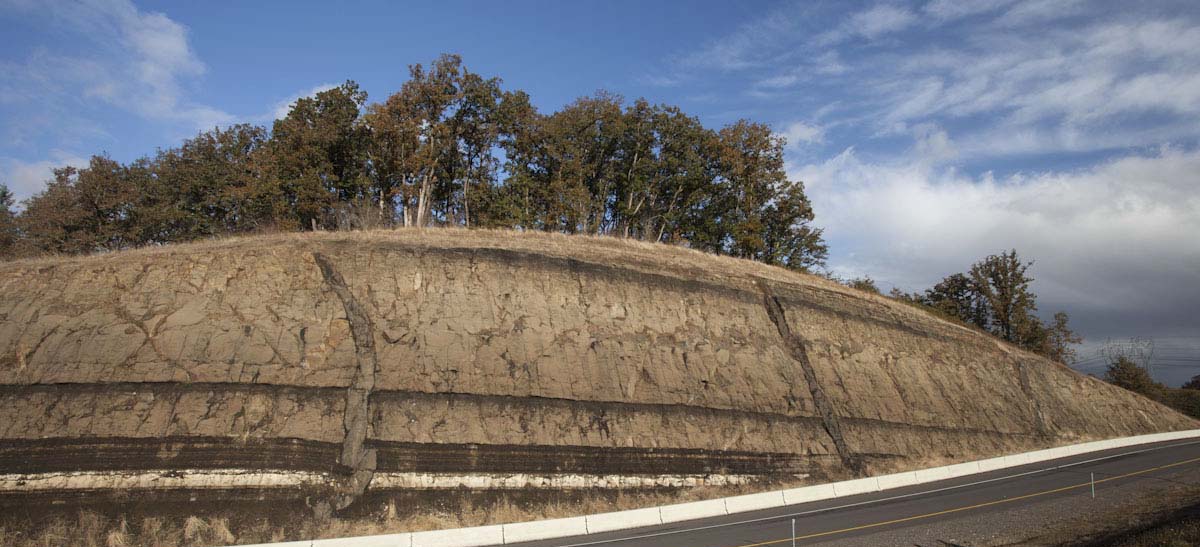
You don’t see many rocks where I live in western Oregon. Lush forests or savannah-like areas dotted with Oak, yes, but the bedrock mostly lies beneath the vegetation and a thick mantle of soil. Just south of town though, the highway cuts through a hillside to expose rock that reminds us of our geologic setting –and taken in context, points to Earth’s incomprehensibly long history.

I’m standing in a soft rain at the foot of the roadcut, looking upwards at some 50 feet of strata. The rocks are sedimentary, having been deposited in lakes and rivers, but there’s also a thin layer of light-gray ash near the top of the cut and a much thicker one near the bottom –and slashing vertically through everything are two narrow gray, almost black, bodies of igneous rock. Called dikes, they worked their way upwards as molten rock along cracks in the older sedimentary rock before cooling and crystallizing where they are now.

Highway Roadcut near Eugene, Oregon

Evidence of ancient volcanic activity abounds: ash, dikes, even the sedimentary rocks are made mostly of volcanic particles. And on clear days, I can walk to the south side of the roadcut and look eastward to forested ridges of the Western Cascades that give way in some 50 miles to the snow-capped peaks of the High Cascades. They’re all volcanic. The High Cascades volcanoes are young and active whereas those of the western Cascades are long extinct and deeply eroded. Combined, the two parts of this range formed over a period of about 40 million years and produced miles and miles of lavas, ash and debris flows, and volcanic-rich sedimentary rocks.

Trying to imagine this 40 million-year history is like watching the stars, filling me with wonder and leaving me humbled, subdued, and exhilarated, all at the same time. And by geologic standards, 40 million years isn’t extremely long. Death Valley, California, one of my favorite haunts, showcases some 30,000’ of sedimentary rock that was deposited over a period of 400 million years, between about 700 and 300 million years ago –and beneath them lies rock that records conditions on Earth’s surface over a billion years ago. Anyone can see these rocks, touch them, and imagine the incomprehensible.

Paleozoic strata in Death Valley

When I was in college, I encountered a textbook passage that helped me visualize geologic time. The author, Don Eicher of the University of Colorado, imagined Earth’s entire 4.54 billion year history compressed into a single year. He pointed out that, in this calendar, Earth’s first organisms would’ve lived sometime in late March, the first creatures that produced shelly fossils appeared November 17, and the first land plants around November 23. He included many noteworthy events, but they didn’t include the Cascade Range. By my calculations, the 40 million years of Cascade volcanic activity existed for about the last three days of this calendar year. The first humans? They appeared about 35 minutes before midnight.

It boggles the mind to think about how much humans have done in those 35 minutes, so much so that we’re considering naming a geologic period of time after ourselves: the Anthropocene. It’s likely that we’d designate it an “epoch” so it would naturally come after our present epoch, the Holocene, which followed the Pleistocene (Ice Age), which followed the Pliocene, and so on. Of course, any formal designation would require people to agree on exactly when it began and for that there is little consensus because humans caused major changes on Earth at different places during different times. The one time most researchers agree affected everywhere at once was the widespread atomic weapons testing in the late 1940s and 1950s, which spread radionuclides across the planet and are now an identifiable part of the sedimentary record.

Folded mylonitic gneiss, Death Valley, California

Without question, humans are an indomitable geologic force, especially since the early 1950’s. It’s no wonder many researchers call that time “The Great Acceleration”, when our technology and energy use increased exponentially. And less than 40 years later during the 1990s, we recognized that our activities move more material each year than any other natural force such as rivers or landslides or glaciers. Since then, our “bioturbation” has only increased. We have colonized every habitable nook and cranny on this planet and are precipitating environmental catastrophes we’re only beginning to comprehend.

But to call this human time period a geologic epoch seems to imply a certain longevity to both the period and to its trademark origin: Homo sapiens –and since 1950, the earth has aged barely a half second in its year-long calendar. I wonder how much longer we can last. To me, the concept of the Anthropocene as an epoch seems contingent on us surviving our environmental crises and continuing for thousands of years. After all, the Holocene Epoch, which it would replace, lasted for 10,000 years, and all the epochs before lasted millions. Instead of a new epoch, we may instead be in a transitional period from the Holocene to something that postdates Homo sapiens. If that’s the case, then we’re witnessing more of dramatic event: mass extinctions and environmental changes that will herald an altogether different ecosystem.

I reach down at my feet and untangle a wet plastic bag from some rocks that have fallen from the roadcut. So different, yet both pieces of sediment just the same. Both may find their way into the rock record. I wonder how our part of the record will appear long after our time has passed. I imagine we’ll be a readily identifiable layer, thick in some places and thin in others, and everywhere representing the same moment in time. It won’t be an epoch, but a fleeting second or two in Earth’s year of ages.

.

Photos available for free download on geologypics.com

Iceland –where you can walk a mid-Atlantic rift –and some other geology photos

While Iceland hosts an amazing variety of awesome landscapes, what stands out to me most are its incredible exposures of the Mid-Atlantic ridge. To the north and south, the ridge lies beneath some 2500m of water, forming a rift that separates the North American plate from the Eurasian plate. The rift spreads apart at a rate of some 2.5 cm/year, forming new oceanic lithosphere in the process. But in Iceland, you can actually walk around in it!

Please click on any of the images below to see them enlarged.

Iceland2geomapplates

Geologic map of Iceland as compiled from references listed below.

Read more…

Grand Canyon Unconformities –and a Cambrian Island

A prominent ledge punctuates the landscape towards the bottom of the Grand Canyon. It’s the Tapeats Sandstone, deposited during the Cambrian Period about 520 million years ago, when the ocean was beginning to encroach on the North American continent, an event called the Cambrian Transgression. Above the ledge, you can see more than 3000 feet of near-horizontal sedimentary rocks, eroded into cliffs and slopes depending on their ability to withstand weathering and erosion. These rocks, deposited during the rest of the Paleozoic Era, are often used to demonstrate the vastness of geologic time–some 300 million years of it.

View of the Grand Canyon from the South Rim trail. Arrows point to the Cambrian Tapeats Sandstone.

View of the Grand Canyon from the South Rim trail. Arrows point to the Tapeats Sandstone.

But the razor-thin surface between the Tapeats and the underlying Proterozoic-age rock reflects the passage of far more geologic time  –about 600 million years where the Tapeats sits on top of the sedimentary rocks of the Grand Canyon Supergroup. Those rocks are easy to spot on the photo above because they contain the bright red rock called the Hakatai Shale. Even more time passed across the surface where the Tapeats sits on top of the 1.7 billion year old metamorphic basement rock. You can put your thumb on the basement and a finger on the Tapeats –and your hand will span 1.2 billion years! Read more…

Sampling New Zealand’s (Amazing) Geology

New Zealand’s landscape can make just about anybody appreciate geology. Its glaciated peaks, its coastline –that ranges from ragged cliffs to sandy beaches to glacial fjords– its active volcanoes… they all work together to shout “Earth Science!” With that in mind, here’s some basics of New Zealand’s amazing geology, followed by some geological highlights of my trip of January and early February, 2018.

NZ map--all

Map of New Zealand, showing accreted terranes in colors and cover assemblage in gray. (Compiled mostly from Graham, 2015)

North and South Island Bedrock  The different colors on this map show New Zealand’s basement rock, named so because it forms the lowest known bedrock foundation of any given area. The basement tells stories of New Zealand’s deep past, from about 500-100 million years ago. Individual colors signify different terranes, accreted (added) one-by-one through plate motions to the edge of what was then the supercontinent Gondwana. They mostly consist of sedimentary and metamorphosed sedimentary rock, although the narrow belt of purple-colored Dun Mountain Ophiolite formed as oceanic lithosphere, and the red-colored areas consist of granitic igneous rock, some of which has been metamorphosed to gneiss.

Gray indicates the younger cover rock, formed after accretion of the terranes. Consisting of a wide range of sedimentary and volcanic rocks, as well as recently deposited sediment, it’s just as interesting and variable as the terranes. Because it includes volcanoes, it’s largely the cover that gives the North Island its distinctive flair. By contrast, the South Island consists largely of uplifted basement rock, much of which has been –and still is—glaciated. All those long deep lakes, such as Lakes Wanaka and Tekapo, were carved by glaciers and are now floored with their deposits of till.

Andesite stratovolcano, New Zealand

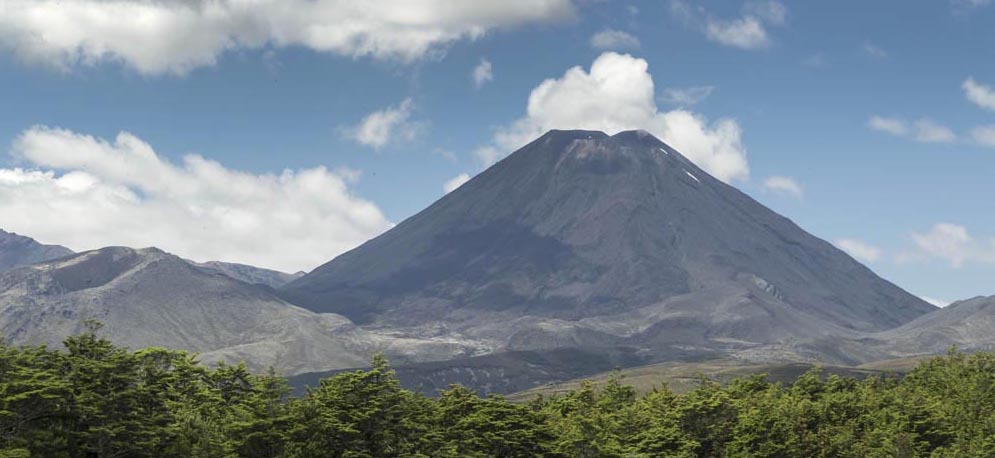
Mt. Ngauruhoe, a 7000 year-old andesite stratocone near Ruapehu on the North Island

Those differences exist largely because the North and South Islands occupy different plate tectonic settings. The North Island sits over a subduction zone, so it hosts an active Read more…

Cove Palisades, Oregon: a tidy short story in the vastness of time

If I were a water skier, I’d go to Lake Billy Chinook at Cove Palisades where I could ski and see amazing geology at the same time. On the other hand, I’d probably keep crashing because the geology is so dramatic! Maybe a canoe would be better.

Lake Billy Chinook, Oregon

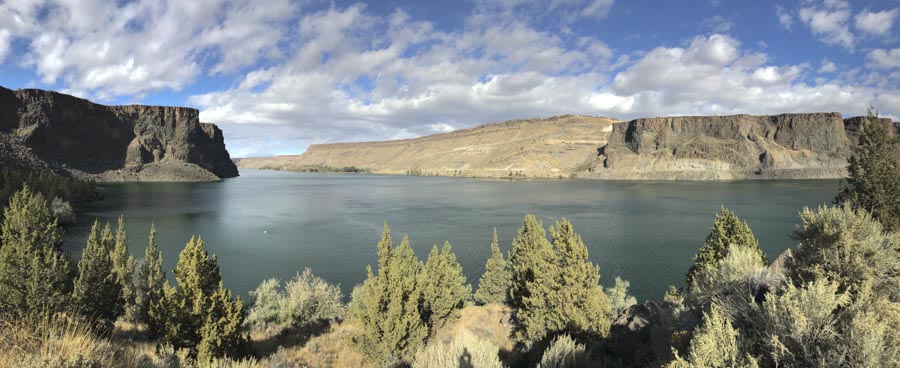
View across the Crooked River Arm of Lake Billy Chinook to some of the 1.2 million year old canyon-filling basalt (right) and Deschutes Fm (left). The cliff on the far left of the photo is also part of the 1.2 million year basalt.

The lake itself fills canyons of the Crooked, Deschutes and Metolius Rivers. It backs up behind Round Butte Dam, which blocks the river channel just down from where the rivers merge. The rocks here tell a story of earlier river canyons that occupied the same places as today’s Crooked and Deschutes Rivers. These older canyons were filled by basaltic lava flows that now line some of the walls of today’s canyons.

CovePalisades2From the geologic map, modified from Bishop and Smith, 1990, you can see how the brown-colored canyon-filling basalt, (called the “Intracanyon Basalt”) forms narrow outcrops within today’s Crooked and Deschutes canyon areas. It erupted about 1.2 million years ago and flowed from a vent about 60 miles to the south. You can also see that most of the bedrock (in shades of green) consists of the Deschutes Formation, and that there are a lot of landslides along the canyon sides.

The cross-section at the bottom of the map shows the view along a west-to-east line. Multiple flows of the intracanyon basalt filled the canyon 1.2 million years ago –and since then the river has re-established its channel pretty much in the old canyon. While the map and cross-section views suggest the flows moved down narrow valleys or canyons, you can actually see the canyon edges, several of which are visible right from the road.

Read more…

Geologypics.com– A new (and free) resource for geological photographs

What better way to kick off my new website than to write about it on my blog? To see it, you just need to click on the word “home” in the space above. Or you can click the link: geologypics.com.

Here’s part of the front page:
home3

As it says, the site offers free downloads for instructors –and for anybody who’s craving a good geology photograph. It’s my way of contributing to geology education –showing off some of our landscape’s amazing stories and providing resources for other folks who want to do the same.

I think the best part of the whole site is that red button in the middle of the home page. It says “Image Search by Keyword”.

Right now, there are more than 2200 images you can search for — all of which are downloadable at resolutions that generally work for powerpoint. If you search for “sea stack” for example, you’ll get 38 hits –and the page will look like this:

Sea Stack search

First page of sea stacks when you search on the term.


Notice that ALL the photos are presented as squares–which works for most photos, but not all. To help mitigate that, the photos with vertical or panorama formats say so in their title, so you know to click on them to see the whole image. Take the photo in the upper center, for example –it’s got a  vertical format. Here it is:vertial image


A more detailed caption below the photo, along with its ID number appears at the bottom of the pic. This particular image is the chapter opener to the Coast Range in my new book “Roadside Geology of Washington“, which I wrote with Darrel Cowan of University of Washington.

There are also galleries –a chance to browse a variety of images without having to think of keywords. Similar to the search, they’re presented as squares so you need to click on the photo to see the whole thing.


Here’s what the photo gallery page looks like (on the left), followed by part of the “glaciation” page you’d see if you clicked on “glaciation”.  Woohoo!

galleries

part of Galleries page (left) and part of Glacial page (right)


Then there’s the “About” page, which gives some information about me and details my policies regarding use of the images (basically, you can download freely for your personal, non-commercial use if you give me credit; if you want to use the image in a commercial publication you need to contact me to negotiate fees). There’s also a “News” page, that gives updates on the website. There’s a contact page from which you can send me emails. And the blog? It goes right back to here!

And finally, if you’re looking for a great web designer? Try Kathleen Istudor at Wildwood SEO –she created the site and spent hours coaching me on how to manage it.

Enjoy the site!


Summarizing Washington State’s Geology –in 19 photo out-takes

Washington State displays such an incredible array of geologic processes and features that it makes me gasp –which is one reason why writing “Roadside Geology of Washington” was such a wonderful experience. I also got to do it with my long-time friend and colleague (and former thesis advisor at the University of Washington) Darrel Cowan. The book should be on bookshelves in mid-September –and I can’t think of a better way to celebrate than by summarizing Washington’s amazing geology with a bunch of out-take photos –ones that didn’t made it into the book or even to my editor. Like the photo below:

Mount Baker, Washington (150916-4)

Mt. Baker, a glaciated stratovolcano in northern Washington State.

Mount Baker’s a stratovolcano that erupted its way through the metamorphic rock of the North Cascades. I took the photo from the parking lot at a spot called Artist’s Point –at the end of WA 542 –and my editor nixed it because I already had enough snow-capped volcanoes in the book.

On the cross-section below–which includes elements of Oregon as well as Washington, Mt. Baker is represented by the pink volcano-shaped thing labelled “High Cascades”. The following 15 or so photos illustrate most of the other features on the cross-section –so together, they illustrate much of the geology and geologic history of the state!

Cross-section across PNW

Generalized cross-section across Washington and Oregon.

Washington State and geologic provinces

Washington State and geologic provinces.

A quick note about organization: I’m separating the images according to their  physiographic province. There are six in Washington: Coast Range, Puget Lowland, North Cascades, South Cascades, Okanogan Highlands, and Columbia Basin.


Coast Range:
As you can see in the cross-section, the Coast Range borders the Cascadia Subduction Zone and consists of three main elements: the Hoh Accretion Assemblage in yellow, Siletzia (called the “Crescent Formation” in Washington) in purple, and the post-accretion sedimentary rock in brown. Siletzia is the oldest. It was thrust over the Hoh Accretion Assemblage, which is still being accreted at the subduction zone. The post-Accretion sedimentary rocks were deposited over the top of Siletzia after it was accreted about 50 million years ago.

And here are some photos! Siletzia formed as an oceanic plateau and so is characterized Read more…

Washington’s waterfalls–behind each one is a rock!

Of all the many reasons why waterfalls are great, here’s another: they expose bedrock! And that bedrock tells a story extending back in time long long before the waterfall. This posting describes 9 waterfalls that together paint a partial picture of Washington’s geologic history. The photos and diagrams will all appear in my forthcoming book Roadside Geology of Washington (Mountain Press) that I wrote with Darrel Cowan of the University of Washington.

151107-27flr

Rainbow falls along WA 6 in the Coast Range


And waterfalls in heavily forested areas are especially great because they may give the only view of bedrock for miles around! Take Rainbow Falls, for example–the small waterfall on the left. It’s in Washington’s Coast Range along State Highway 6–a place where a roadside geologist could otherwise fall into total despair for lack of good rock exposure. But this beautiful waterfall exposes a lava flow of the Grande Ronde Basalt, which belongs to the Columbia River Basalt Group. Significant? Yes!

This lava erupted in southeastern Washington and northeastern Oregon between about 16 and 15.6 million years ago and completely flooded the landscape of northern Oregon and southern Washington. We know how extensive these flows are because we can see them–and they cover the whole region. The photo below shows them at Palouse Falls in the eastern part of Washington. Take a look at my earlier blog post about the Columbia River Basalt Group? (includes 15 photos and a map).

Read more…

Oregon’s rocky headlands: geologic recycling through erosion and uplift and erosion…

160227-24t

Crashing waves at Heceta Head, Oregon

You can’t avoid thinking about erosion while standing on one of Oregon’s rocky headlands. The waves keep coming, one after another, each crashing repeatedly against the same rock. Impossibly, the rock appears unmoved and unchanged. How can it not erode?

The answer, of course, is that headlands do erode, quickly, but on a geologic time scale. We just miss out because we live on the much shorter human time scale. And the erosion belongs to a cycle in which coastal uplift causes eroded and flattened headlands to rise and become headlands once again, all subject to more ongoing erosion and uplift.

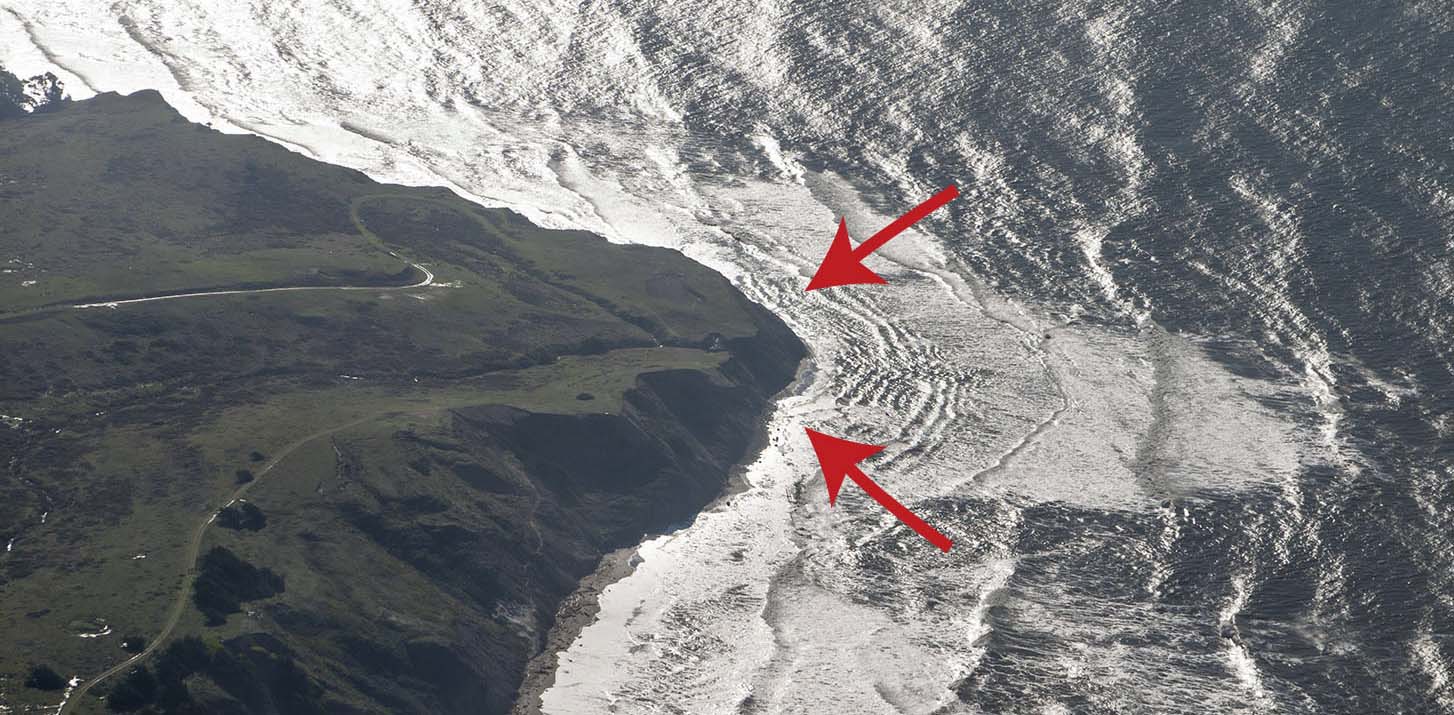
Wave energy is most intense at headlands because the incoming wave typically feels the ocean bottom near the headland first, which causes the wave to refract. As shown in the aerial photo below, this refraction focuses the wave energy on the headland.

CE-06060115-33-arrowsc

Wave refraction causes wave energy to focus on the headland. Arrows are perpendicular to wave fronts.

As you can see in the next few images, headlands don’t erode evenly. They erode irregularly, as the waves exploit any kind of weakness in the rocks such as faults and fractures, or if they’re sedimentary, bedding surfaces. The products of this erosion are as beautiful as they are interesting: sea stacks, sea arches, sea caves… The list goes on and on.

Headland and lighthouse, Heceta Head, Oregon

Aerial view of Heceta Head, Oregon.

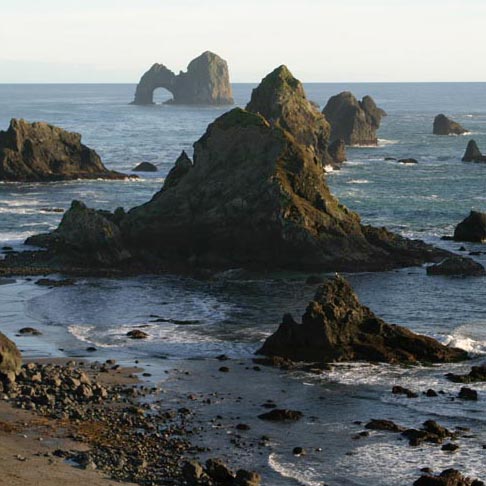
From the above photo, you can see that sea stacks are simply the leftover remains of a headland as it retreats from erosion. That’s a critical point, because some sea stacks, especially the one with the arch in the photo below, are a long way from today’s coastline.

Sea stacks and sea arch, southern Oregon

Sea stacks and sea arch, southern Oregon

Those rocks, 1/4 to a 1/2 mile away used to be a part of the coastline? The land used to be way out there? YES!!! For me, that’s one of the very coolest things about sea stacks –they so demonstrate the constant change taking place through erosion.

Taken to its extreme, erosion renders headlands into wave-cut platforms, such as the one below at Sunset Bay. Being in the intertidal zone, these platforms make great places for tide-pooling–and ironically, for people-watching too. Geologically, they form important markers because they’re both flat and form at sea level. When found at higher elevations, they indicate uplift.

Wave-cut bench, Sunset Bay, Oregon

Wave-cut bench at Sunset Bay, Oregon

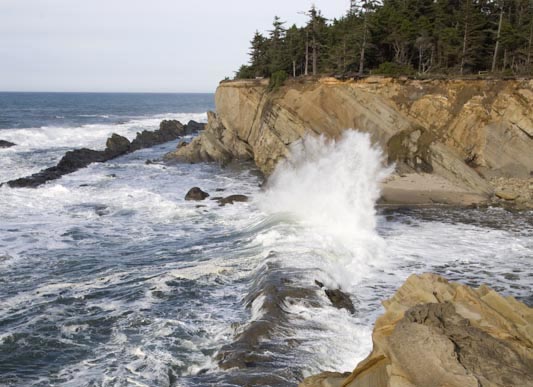
In fact, looking carefully at the photo above, you can see a flat surface on the other side of the bay. It’s an uplifted wave-cut platform! Called a marine terrace, it’s covered by gravel and sand originally deposited in the intertidal zone. Those deposits rest on bedrock that, at an earlier time, was also flattened by the waves. The photo below shows a better view of this terrace from the other side.

5D-8922clr

Breaking wave at Shore Acres State Park, Oregon. Tree-covered flat surface in the background is an uplifted marine terrace.

These uplifted marine terraces can be found up and down Oregon’s coastline. Researchers recognize several different levels, the oldest being those uplifted to highest elevations. The one in the photo above at Shore Acres State Park is called the Whiskey Run Terrace and formed about 80,000 years ago. You can see a similar-aged terrace below as the flat surface beneath the lighthouse at Cape Blanco, Oregon’s westernmost point. An older, higher terrace forms the grass-covered flat area on the right side of the photo.

Cape Blanco, Oregon

Cape Blanco, Oregon looking NE. The flat surface beneath the lighthouse is the ~80,000 year-old Cape Blanco Terrace, probably equivalent to the Whiskey Run Terrace at Shore Acres; the flat area on the right side of the photo is the higher Pioneer Terrace,  formed ~105,000 years ago.

Researchers take the approximate ages of the terraces and their elevations to calculate approximate rates of uplift. In this area, Kelsey (1990) estimated a rate of between 4-12 inches of uplift every 1000 years. That might seem slow, but over hundreds of thousands of years, it can accomplish a great deal.

And look! The uplifted terraces? They’re on headlands! Of course, because they’ve been uplifted! And the headlands are now eroding into sea stacks and then platforms –to be uplifted in the future and preserved as marine terraces that sit on top headlands. And on and on, as long as the coastline continues rising.

YachatsWaves1-4

Blowhole near Yachats, Oregon. Incoming wave funnels up a channel eroded along a fracture and explodes upwards on reaching the end.

Some links and references:
Kelsey, H.M., 1990, Late Quaternary deformation of marine terraces of the Cascadia Subduction Zone near Cape Blanco, Oregon: Tectonics, v. 9, p. 983-1014. (Detailed study of Cape Blanco, including uplift rates).

Miller, M., 2014, Roadside Geology of Oregon, Mountain Press, Missoula, 386p. (General reference which details the concepts and includes several of the photos used here).

Earth Science Photographs: free downloads for Instructors —or anybody! (my webpage)

Post Navigation