geologictimepics

Geology and Geologic Time through Photographs

Archive for the category “Geologic Time”

Great Unconformity –Grand Canyon, Arizona

So just like intrusive igneous rocks, metamorphic rocks require great lengths of time to accomplish the uplift and erosion in order to be exposed at Earth’s surface.

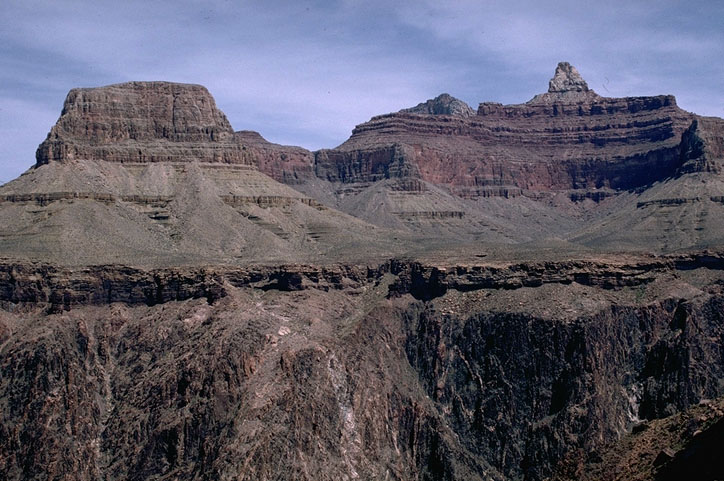
So what do we make of this photograph?  It shows a sequence of sandstone, shale, and limestone sitting on top metamorphic rock (called the “Vishnu Schist”) in the Grand Canyon.  The sandstone was deposited right on top the schist.
Great unconformity, Grand Canyon, Arizona

Sequence of Cambrian sandstone (the ledge across the middle of the photo), shale (the overlying slopes) and limestone (the upper cliffs) deposited on top the Vishnu Schist in the Grand Canyon.


Since sedimentary rocks, like sandstone, shale, or limestone, are deposited at Earth’s surface –and metamorphic rock forms beneath the surface, this photo shows that BEFORE the sedimentary rocks were deposited, the metamorphic rock (schist) had to have been uplifted and exposed.  So all the time required to bring the schist to the surface had to take place before the sandstone was even deposited.

The surface of contact between the sandstone and the schist is called an unconformity because it is here that we see evidence for a great deal of missing rock record.  The sandstone must be much younger than the schist –for the very reason that the schist first had to get uplifted and exposed at the surface before the sandstone was deposited on top of it.  So… because the sandstone is so much younger, but it was deposited right on top the schist, there must be a gap in the rock record between them … an unconformity.

And here is where we see evidence for even LONGER periods of time.  Overlying the sandstone?  Thousands and thousands of feet of more sedimentary rock.  And much of that sedimentary rock was marine… formed at sea level.  It is now over a mile above sea level.

And the schist itself?  The people who’ve studied it have determined that much of it was originally volcanic –which means that it originally formed at the Earth’s surface.  So… over geologic time, it must have been buried to the depths needed to turn it into a metamorphic rock BEFORE it was uplifted and exposed.

So… how old is Earth?  Some say 6 or 10,000 years… I think we’re looking at 10s of millions in this photo.  And if we consider the numerical ages for these rocks, 1.7 billion is the age of metamorphism of the schist –its original volcanic rock must have been older!

Metamorphic Rock

Metamorphic rock, just its very existence at Earth’s surface, signifies great lengths of geologic time –on the order of millions of years.

Consider this rock, high in the Teton Range of Wyoming.

Folded gneiss, formed at depths of 10 km or more, high in the Teton Range of Wyoming.

This is a metamorphic rock called gneiss –in a lot of ways, it’s like granite, because it contains a lot of the same minerals –but gneiss forms because an older rock (in this case, probably a granite) was heated to high enough temperatures that its minerals recrystallized into new minerals.  And most metamorphism also involves high pressures, so all the new crystals form in a particular arrangement (as opposed to granite, in which the crystals are randomly arranged) –that’s how the layering (called “foliation”) forms in metamorphic rocks: the recyrstallization of new minerals under pressure.

Close-up view of gneiss, showing crystals that formed in the same orientation, as a result of recrystallization while under directed pressure. The layering is called "foliation"

But the key thing here, is that metamorphic rocks form WITHIN the Earth, at depth –and just like granite, require uplift and erosion to get to the surface.  This gneiss formed at depths of 10 km or more and was then uplifted to its present elevation, nearly 4 km above sea level.  –which requires time.

click here to see more photos of metamorphic rocks
click here to see a geologic map of Grand Teton National Park, Wyoming.

Cambrian rock

–the last posting, (March 21) had a photo of granite of the Cretaceous Sierra Nevada Batholith intruding Cambrian sedimentary (now metamorphosed) rocks.  These photos show more Cambrian rock.  The Cambrian Period (542-488 million years ago) is the bottom of the Phanerozoic Eon –and one reason Cambrian rocks are significant, is that they are the oldest rocks to contain shelly fossils.  Older rocks, called “Precambrian” may contain fossil impressions or fossilized algae, but don’t contain any shells.

At the risk of being too repetitive (see post March 13) the upper photo shows Cambrian limestone in the Death Valley region –there are thousands of feet of Cambrian Limestone in the Death Valley region.   The lower photo shows Cambrian sandstone, shale, and limestone overlying tilted Precambrian sedimentary rock in the Grand Canyon.

My point is that the Cambrian section is traceable over great distances.  That’s important, because the base of the Cambrian provides a common datum over much of the western US –certainly from the Sierra Nevada to Death Valley to the Grand Canyon –but in later posts, you can see that it’s also in Colorado, Wyoming, Montana… and so on!

Cambrian limestone in the Nopah Range, SE Californi

Thousands of feet of marine limestone make up many of the mountain ranges in the Death Valley area of SE California. Click here to see a geologic map of Death Valley National Park...

The photo above shows the Cambrian Bonanza King Formation (gray) on top the Cambrian Carrara Fm (orange).

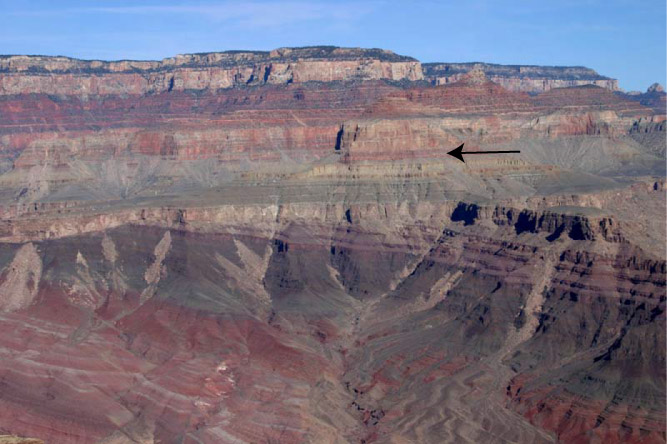
And the photo below shows the near-horizontal Cambrian and younger rocks of the Grand Canyon over tilted Precambrian sedimentary rock.  It’s really thin here… the Cambrian only goes up through the arrow.

Cretaceous batholiths and roof pendants

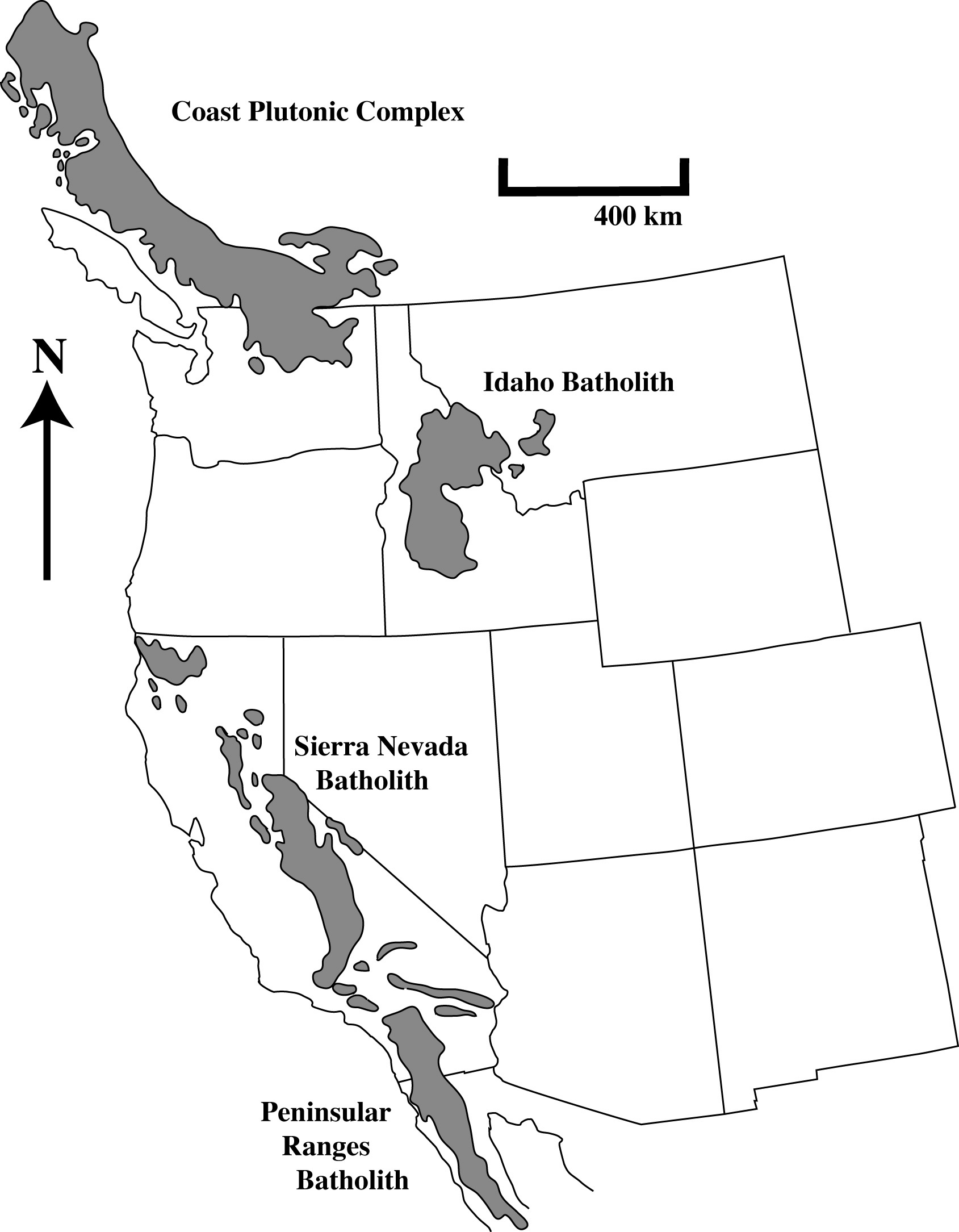
The photos from the last posting were from the Sierra Nevada Batholith –called a “batholith” because it consists of many many smaller intrusive bodies that collectively define a much larger intrusive complex that doesn’t even have a well-defined root.  As it turns out, the Sierra Nevada are one of several really large batholiths that intruded the crust of the Pacific Margin during the Cretaceous Period, about 80-100 million years ago.

Granitic Batholiths of Cretaceous age in western North America.

And along the east side of the Sierra Nevada, we can see the original rock into which the granite of the Sierra Nevada intruded.  This original rock consists of older sedimentary and volcanic rock–that dates from the Cambrian Period through the Jurassic– much of which was metamorphosed by the heat from the intruding granite.  The photo below shows the Cretaceous granite below (light colored rock) and the dark-colored sedimentary (now metamorphic) rock above.  These older rocks that are intruded by the granite are called “roof pendants” because they show the roof of the batholith.

Cretaceous granite intruding Cambrian metasedimentary rock, Sierra Nevada Range.

And as far as geologic time goes, this photo shows us that the granite, discussed in previous posts, is younger than the sedimentary rock that overlies it.

And click here to see a photo of glaciated granite in Yosemite National Park.


Granite

That’s actually the moon at the end of the crack in this rock…

granite and moon, Sierra Nevada, California.

A typical exposure of granite --coarse grained with an interlocking, random assortment of crystals. Click here to search for geology pictures by keyword.

And the rock is a pretty typical example of granodiorite… which is a lot like granite, except it has a little less silica.  See yesterday’s post about igneous rocks if you’re interested.

It turns out that most of the Sierra Nevada Range in California, including Mt. Whitney (the conterminous US’s highest peak) is made out of granodiorite.  And if you consider that most of the magma cooled and crystallized at a depth of 10km, and now resides about 4km ABOVE sea level, we’re looking at millions of years to accomplish this uplift.

Here’s Mt. Whitney at sunrise… It’s the peak just left-of center.  From this view, you can see that the rock of this part of the Sierra Nevada Range is all pretty much the same: granodiorite.

Mt. Whitney and Sierra Nevada, California at sunrise. Mt. Whitney's elevation is 14, 505' above sea level, the highest spot in the conterminous US. The rock in this photograph is almost entirely granodiorite.

Post Navigation