geologictimepics

Geology and Geologic Time through Photographs

Archive for the category “photography”

Geologic field trip from Yellowstone Lake to Portland, Oregon at 30,000 feet

What a start to the new year!  January 1, I flew home to Oregon with a north-facing window seat on a spectacularly clear day.  So much incredible landscape!  So much incredible geology!  Here are nine photos I shot out the plane window, keyed to the geologic map below.
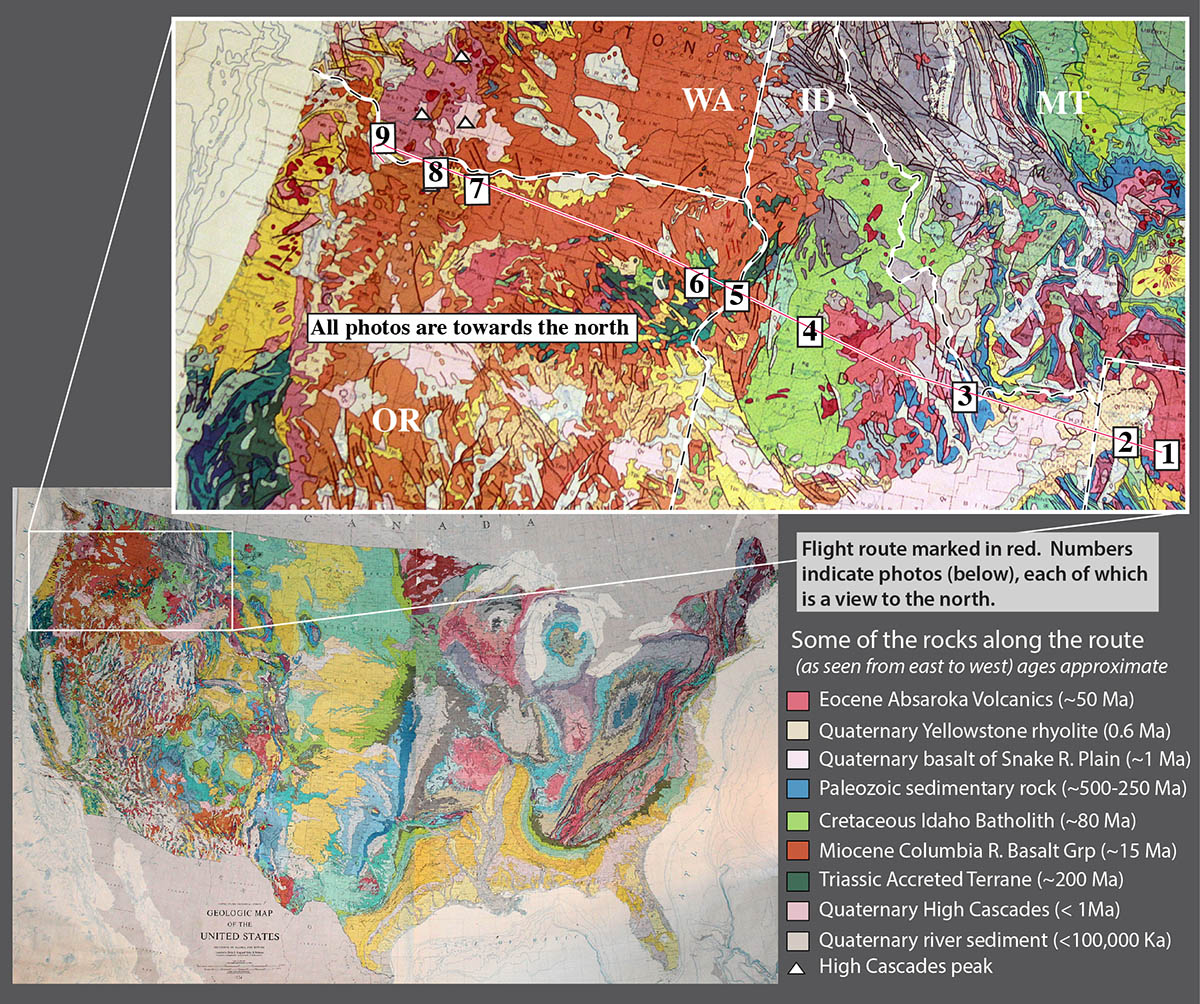
Yel-PDX + US map

Photo 1.  Absaroka Range, northern Wyoming and southern Montana.  You can see that these mountains consist of layered rocks (see bottom of photo especially)–but they’re not sedimentary.  They are basaltic to dacitic lava flows and pyroclastic rocks of the Absaroka Volcanic Field,  erupted from about 53-43 million years ago.  Much of the present topography is the result of glacial erosion during the Pleistocene.

Absaroka Range, east edge of Yellowstone Lake on left.

Absaroka Range, east edge of Yellowstone Lake on left.

Photo 2.  Yellowstone Lake.  As you can see on the map, Yellowstone Lake fills only a fraction of the caldera created by Yellowstone’s Lava Creek Eruption, 600,000 years ago.  Since then, rhyolite lavas, shown in pink, filled in the caldera.  Notice the oval-shaped bay at the end of the lake’s western arm.  It’s called West Thumb, and is a younger caldera that erupted about 150,000 years ago.  It’s a caldera within a caldera!  It’s pretty big too– almost identical in size to Crater Lake in Oregon –but compared to the main caldera, it’s tiny.

Photo and geologic map of Yellowstone National Park

Photo and geologic map of Yellowstone National Park. The dashed red line marks the caldera edge.

Photo 3. Recent faulting of the Basin and Range Province. In this photo, the Pahsimeroi River flows northwestward to its confluence with the Salmon River, near the left side of the photo –and the Salmon continues flowing northward for about 100 miles before it turns westward and eventually joins the Snake River.
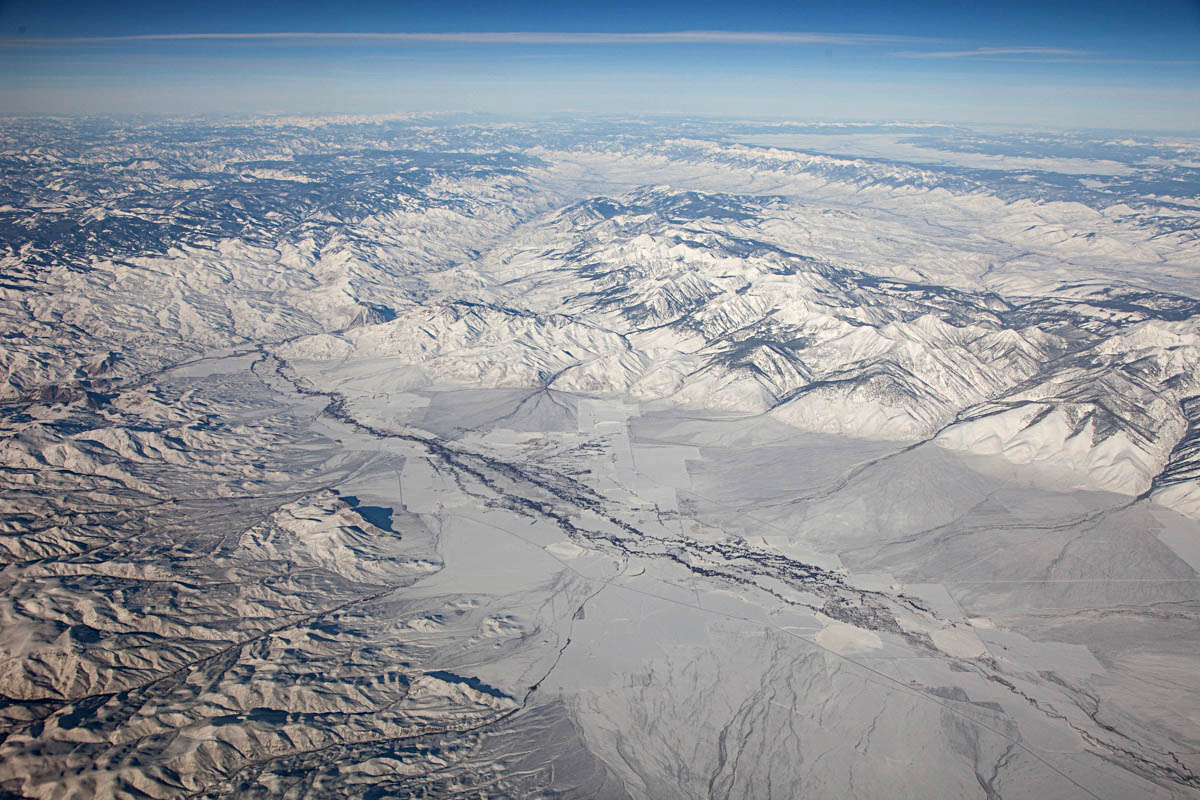
Recent faulting along western edge of Lemhi Range, Idaho.

Recent faulting along eastern edge of Pahsimeroi Valley, Idaho–and western front of Lemhi Range.

But what I think is so cool about this photo is that it so clearly shows the abrupt western edge of the Lemhi Range, which runs diagonally from the right (east) side of the photo to just above the center.  The range literally rises right out of the ground.  That abruptness is caused by faulting that takes place recently and frequently enough that erosion doesn’t keep up with it.  The fault is a normal fault, caused by crustal extension.  Notice the linear nature of the ranges to the northeast (upper right) –More normal faulting!  This is a northern expression of the Basin and Range Province.  Woohoo!

Photo 4. Mountains of the Idaho Batholith.  Granitic rock of the Idaho Batholith underlies a huge area of Idaho, some 14,000 square miles of it. On the geologic map, it’s the big green area.  The rock intruded as a series of plutons during the Late Cretaceous, from about 100 – 65 million years ago.  Similar in age and composition to the Sierra Nevada Batholith, the Idaho Batholith was fed by magma created during subduction along the west coast of North America.
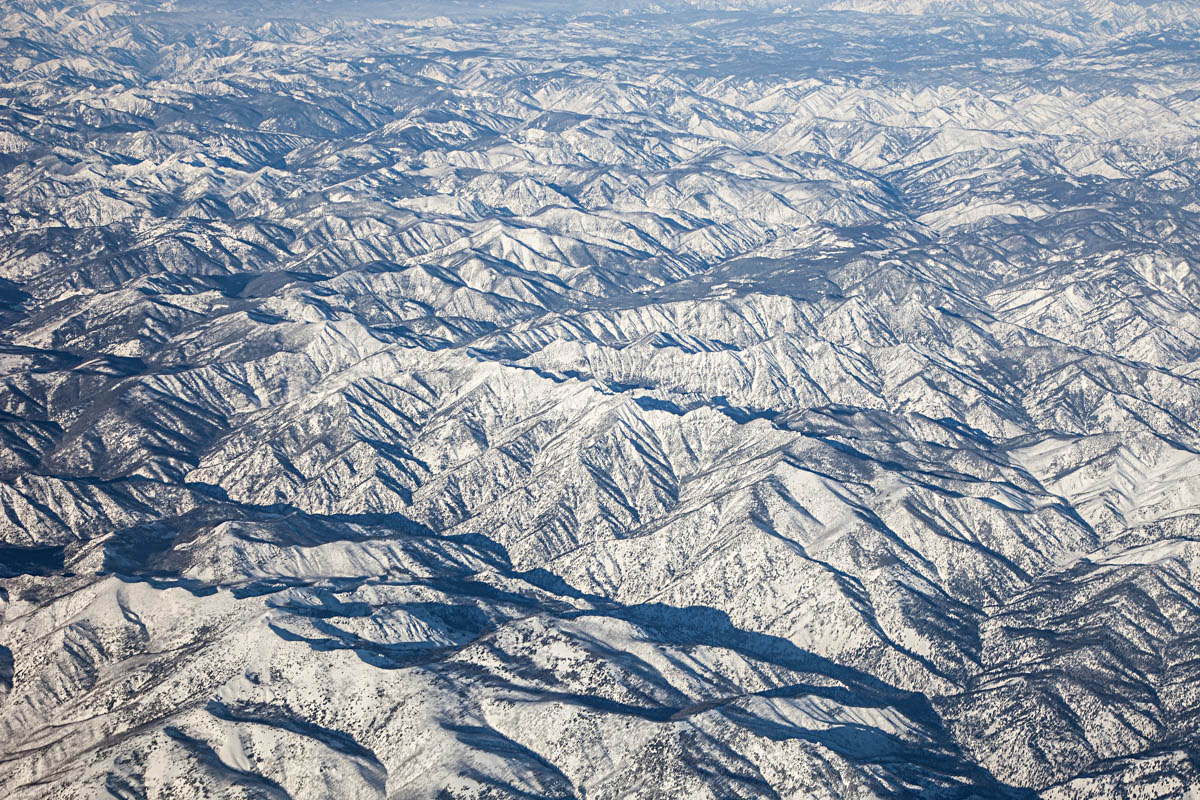
Mountains of the Idaho Batholith

Mountains of the Idaho Batholith

Photo 5. Hell’s Canyon.  Not only does the north-flowing Snake River in Hell’s Canyon form the boundary between Idaho and Oregon (Yay, we made it to Oregon!), and not only is it the deepest canyon in the conterminous United States, but it’s also incredibly important from a geologic-history-of-western-North-America point-of-view.

Notice the flat areas above the canyon–they’re especially visible on the west (left) side, but you can also see them on the east.  Those places are flat because they’re made of flat-lying basalt of the Columbia River Basalt Group. These basalts erupted mostly between 17-14.5 million years ago, but kept erupting off and on until about 6 million years ago –and they cover ALL of northern Oregon and ALL of southeastern Washington State.  In fact, they flowed all the way to the Pacific Ocean.
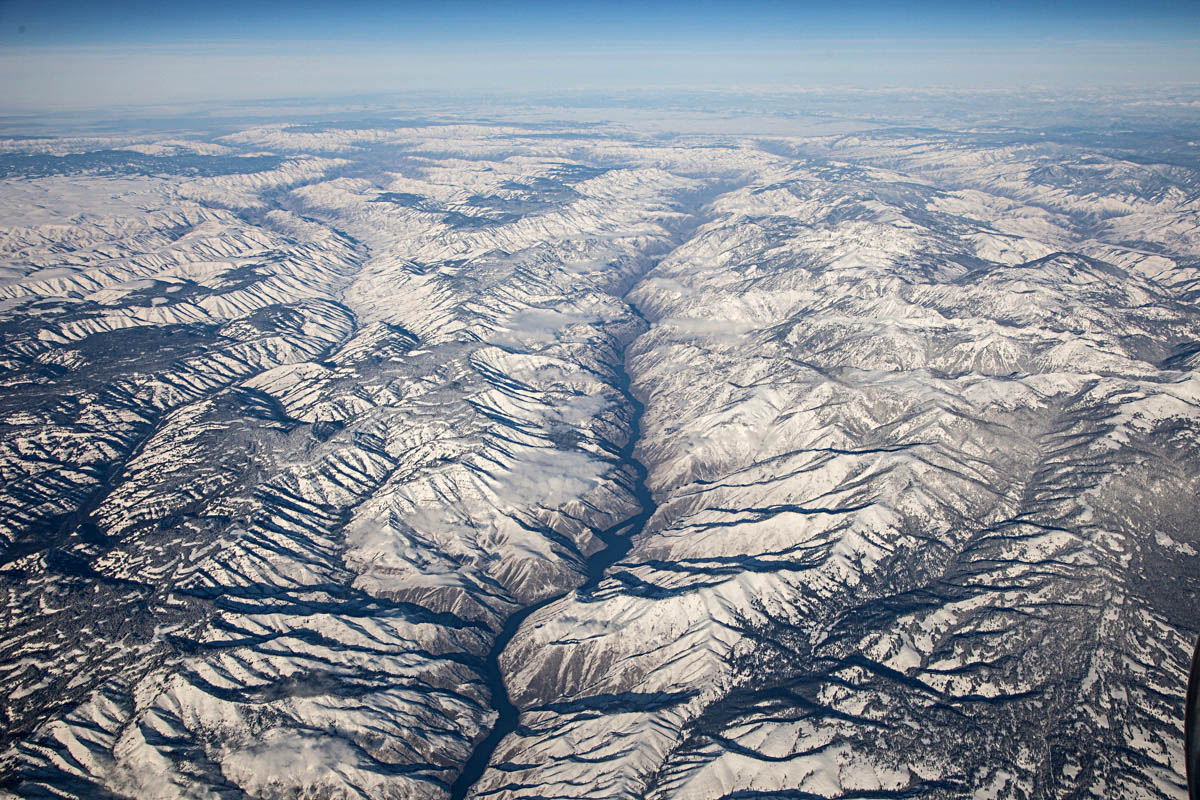
Hell's Canyon and the Snake River.

Hell’s Canyon and the Snake River. The Imnaha River forms the next deep canyon to the left (west).

Those basalt flows overlie rock of the Wallowa accreted terrane: mostly volcanic and sedimentary rock that formed in an island arc setting, far offshore from North America.  It was added (accreted) to the North American continent during the Mesozoic –probably some 150 million years ago.

Photo 6. Wallowa Mountains, Oregon. Just west of Hell’s Canyon are the Wallowa Mountains, Oregon’s premier alpine country outside of the Cascades.  Like Hell’s Canyon, the Wallowas contain the accreted Wallowa terrane overlain by Columbia River Basalt –but the Wallowas also host the Wallowa Batholith, a Jurassic-Cretaceous granitic “stitching pluton”.  It’s called a stitching pluton because it intrudes across accreted terranes and “stitched” them together.

Glacial valleys and frontal fault zone on the north side of the Wallowa Mountains, Oregon.

Glacial valleys and frontal fault zone on the north side of the Wallowa Mountains, Oregon.

You can see a bunch of other things in this photo though.  First off, the mountains end suddenly in a line: a recently active fault zone that has uplifted them more than 5000′ relative to the valley floor. Also, you can see how glaciers carved the landscape.  Notice the deep U-shaped valleys, cirques, and knife-edged ridges called aretes.  And see the lake in the upper right corner of the photo?  It’s Wallowa Lake, dammed by a glacial moraine!

(at this point, the folks in the seats next to me wanted to throw me out of the airplane)

Photo 7. View of Washington High Cascades over The Dalles.  That’s Mt. St. Helens on the left (west), Mt. Adams in the middle, and Mt. Rainier in the far distant right.  Mt. Rainier is 90 miles away!

Looking north over the Dalles to Mts. St Helens, Rainier, and Adams.

Looking north over the Dalles to Mts. St Helens, Rainier, and Adams.

These volcanoes are dormant –which means that they’re …sleeping?  And they can awaken at any time.  I remember a college friend of mine wanted to climb Mt. St. Helens in 1979.  It was dormant then, and nobody worried about it.  Then in May, 1980 it erupted violently, blowing off its top 2000′.  Both St. Helens and Mt. Rainier have erupted many times in the past several thousand years; Mt. Adams though, erupted only twice in that period.

Photo 8.  Columbia Gorge, the Washington High Cascades, and the Bonneville Landslide.  From left (west) to right, the volcanoes are Mt. St. Helens, Mt. Rainier, and Mt. Adams.  You can see the Bonneville Landslide along the river on the right side of the photo, directly below the left base of Mt. Adams.  It detached from the cliffs directly behind it about 1450 A.D. and slid right into the river –and it pushed the river about a mile to the south! Just downriver from the landslide, you can see the Bonneville Dam zig-zagging across the river.

View northward over the Columbia River Gorge to the Washington High Cascades.

View northward over the Columbia River Gorge to the Washington High Cascades.

The ridges at the bottom of the photo lead up to Mt. Hood, another dormant stratovolcano and Oregon’s highest peak.  Apparently, the view out the south side of the plane was even more ridiculously cool.

Photo 9. Columbia River, just below Portland.  Right near Portland, the Columbia River turns northward for about 40 miles before it heads west again out towards the Pacific–and it drops only 10 feet in elevation for the whole distance.  The northward deflection of the river is probably the result of uplift of the Portland Hills, which likely began as long as 16 million years ago (they also deflect 16 million year old lava flows of the Columbia River Basalt). That town along the river in the background is St. Helens, Oregon.

View northward, down the Columbia River.

View northward, down the Columbia River, Washington on the right, Oregon on the left.


See more geologic photos of Oregon by typing “Oregon” into the geology search engine on my website –or type “Oregon, aerial” if you want to see aerial shots!  And if you’re suddenly really excited about Oregon geology, please check out the new edition of Roadside Geology of Oregon!

California’s largest lake formed by its largest fault zone: the Salton Sea and San Andreas Fault

With a surface area of nearly 1000 square kilometers (381 square miles), the Salton Sea is California’s largest lake.  But it’s relatively shallow –and because it has no outlet, it’s saltier than ocean water.  It formed in 1905 when the nearby Colorado River overwhelmed irrigation canals and flooded the region.  Now it’s an incredibly important migratory bird refuge, fishery, and dumping ground for agricultural waste.  Seems like those things shouldn’t really go together!

Aerial view of the Salton Sea, looking northward.

Aerial view of the Salton Sea, looking northward.

But it just seems young.  The Salton Sea actually occupies part of the Colorado River Delta –and as a result, has been filled with freshwater multiple times since the delta was first constructed, probably near the beginning of the Pleistocene.  It’s also at the remarkably low elevation of 234 feet (71m) below sea level; the deepest part of the lake is 44 feet (13 m) below that.

And the low spot is there because of extension caused by the San Andreas fault system!  The San Andreas fault terminates along the eastern margin of the lake basin, but steps across the lake to the Imperial fault, which forms its western margin.  Both faults are right-lateral –and because they step to the right, they pull the area apart in-between them.  Kind of like central Death Valley –which is even lower in elevation than the Salton Sea!  But more on Death Valley later.

Aerial view of Salton Sea, with the approximate locations of the southern San Andreas and Imperial faults.  Note how right-lateral slip on the two en-echelon faults drive extension between them.

Aerial view of Salton Sea, with the approximate locations of the southern San Andreas and Imperial faults. Note how right-lateral slip on the two en-echelon faults drive extension between them.


click here to see more photos of the San Andreas fault system, or click here to see a photo geology tour of Death Valley, California.

Cloudy afternoon waving at the Stawamus Chief–lovely spot and deep time

My friend Jessica and I skipped out from the Geological Society of America meeting in Vancouver last weekend to go visit the Stawamus Chief –a gigantic granite monolith near the town of Squamish.  What a lovely place –and what a great respite from the craziness of a big meeting in a big city!

I don’t want to repeat myself too much, because I wrote about this in an earlier post–but just the fact that granite is exposed at the surface requires deep time –inconceivably great lengths of time.  That’s because granite forms from a molten state by slow cooling and crystallizing far beneath Earth’s surface –10 km or more usually –and THAT means the rock had to get uplifted and exposed at Earth’s surface through processes that we humans perceive as time-consuming–on the order of millions of years.  Additionally, all the rock that used to be above the granite had to get eroded away in the process.

Stawamish Chief rises some 2000 feet above us --a trail leads to the top.

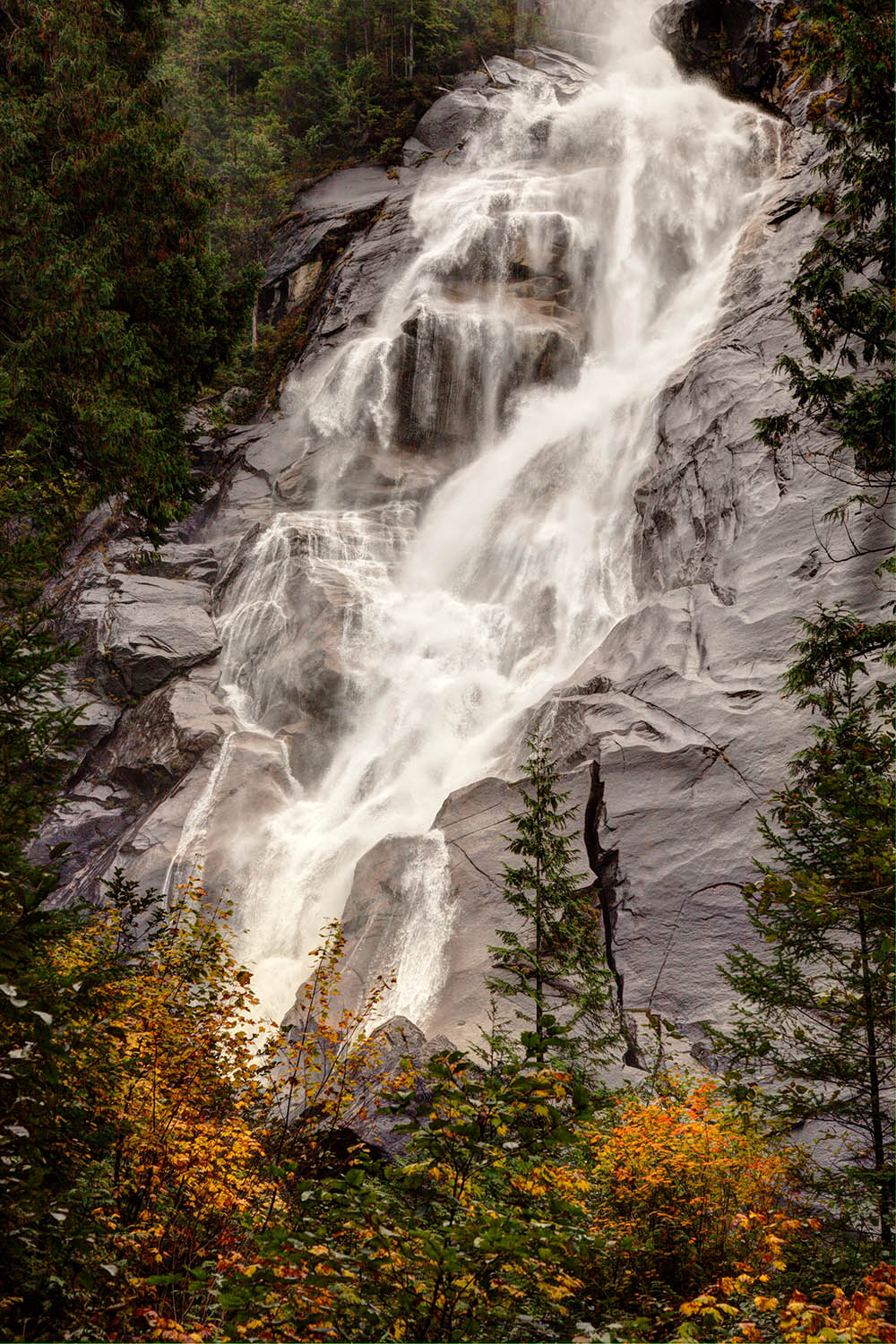
And Shannon Falls is right there too–Amazing!  It sprays about 1000′ down a series of cliffs–and allows a good, up-close look at the granite.  It’s actually granodiorite –which is a lot like granite except that it contains a lot more plagioclase, as opposed to alkali, feldspar.

Shannon Falls, near the bottom of its 1000' drop.

Shannon Falls, near the bottom of its 1000′ drop.

So… the granite speaks to great amounts of time… and the waterfall–it speaks to the changing landscape.  It falls down scoured and smoothed cliffs because the whole area has been shaped by glacial erosion.  Not long ago, this area was under ice!  (Longer though, than the beginning of planet Earth according to the Young Earthers).  You can see some wonderful glacial polish and striations on fluted granite along the highway between the Chief and the town of Squamish.

Glacially carved granite--right next to a large pull-out on the highway.

Glacially carved granite–right next to a large pull-out on the highway.


click here for some more photos of intrusive igneous rocks.

Crater Lake caldera, Oregon –some things happen quickly!

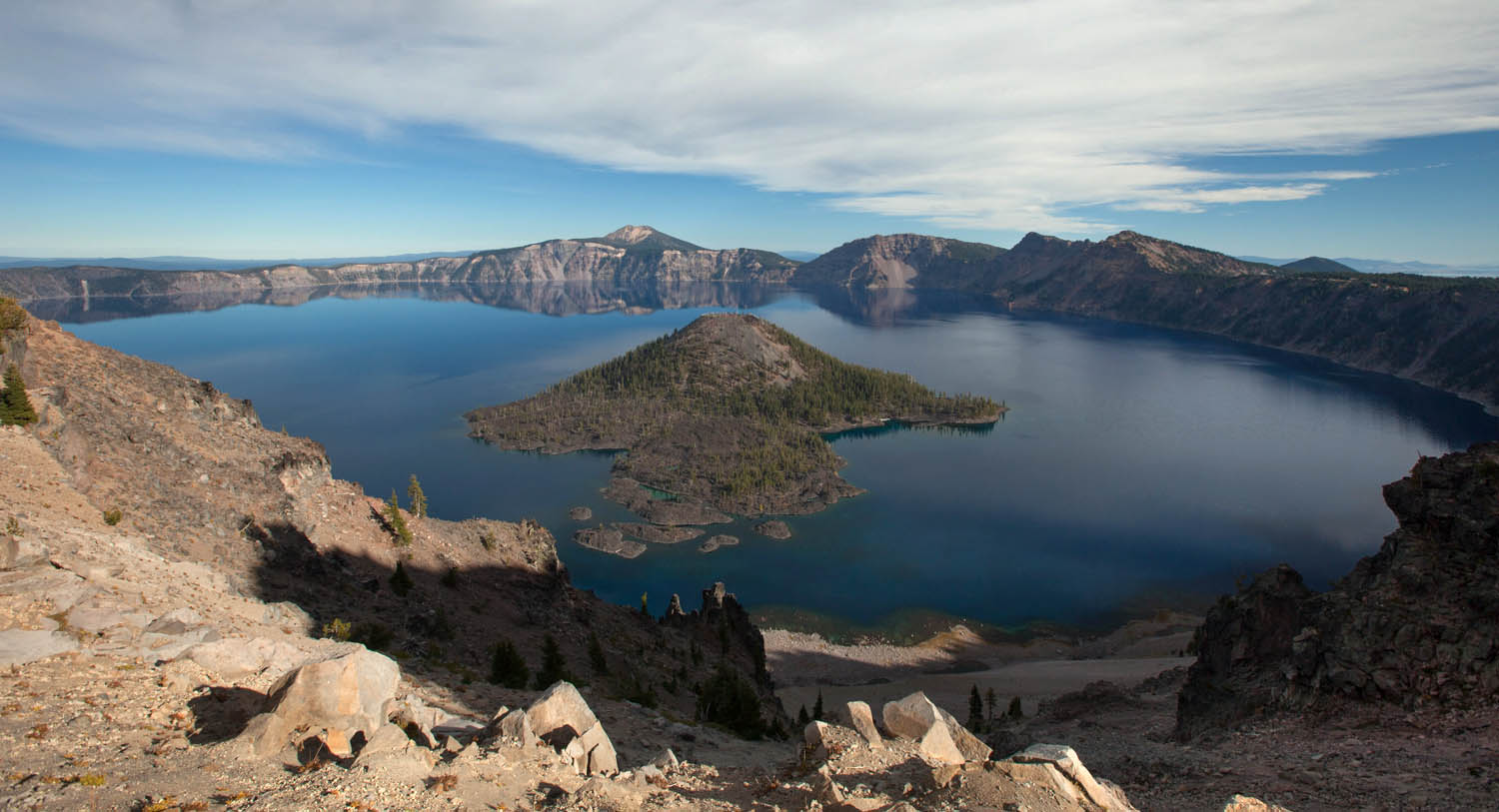
Crater Lake never ceases to amaze me.  It’s huge –some 6 miles (10 km) across, deep –some 1700 feet deep in parts –the deepest lake in the United States and 7th deepest on the planet– incredibly clear, and really really blue.  And for volcano buffs, one of the best places ever!

Crater Lake as seen from The Watchman.  Wizard Island, which formed after the caldera collapse, occupies the center of the photo.

Crater Lake as seen from The Watchman. Wizard Island, which formed after the caldera collapse, occupies the center of the photo.

Crater Lake is a caldera, formed when ancient Mt. Mazama erupted so catastrophically that it emptied its magma chamber sufficiently for the overlying part of the mountain to collapse downward into the empty space.  That was about 7700 years ago.  Soon afterwards, Wizard Island formed, along with some other volcanic features that are now hidden beneath the lake–and then over the years, the lake filled to its present depth.  It’s unlikely to rise any higher because there is a permeable zone of rock at lake level that acts as a drain.

Here’s one of the coolest things about the cataclysmic eruption: Not only was it really big, but it happened really fast.  We know it was big because we can see pumice, exploded out of the volcano, blanketing the landscape for 100s of square miles to the north of the volcano –and we can see the caldera.  We can tell it happened quickly because the base of the pumice is welded onto a rhyolite flow that erupted at the beginning stages of the collapse; the rhyolite was still HOT when the pumice landed on it!  You can see the welded pumice on top the Cleetwood Flow along the road at Cleetwood Cove.

pumice welded onto top of Cleetwood rhyolite flow at Cleetwood Cove.  Note how the base of the pumice is red from oxidation --and forms a ledge because it's so hard.

pumice welded onto top of Cleetwood rhyolite flow at Cleetwood Cove. Note how the base of the pumice is red from oxidation –and forms a ledge because it’s so hard.  Pumice blankets the landscape all around Crater Lake.

Crater Lake though, is so much more than a caldera –it’s the exposed inside of a big stratovolcano!  Where else can you see, exposed in beautiful natural cross-sections, lava flow after lava flow, each of which erupted long before the caldera collapse and built the original volcano? Within the caldera itself, these flows go back 400,000 years–the oldest ones being those that make up Phantom Ship –the cool little island (some 50′ tall) in Crater Lake’s southeast corner.

Phantom Ship, in Crater Lake's southeast corner, is made of the caldera's oldest known rock, at 400,000 years old.

Phantom Ship, in Crater Lake’s southeast corner, is made of the caldera’s oldest known rock, at 400,000 years old.

I can’t resist.  The caldera formed about 7700 years ago, incredibly recent in Earth history–incredibly recent in just the history of Mt. Mazama!  To a young earth creationist though, that’s 1700 years before Earth formed.  Now THAT’S amazing!


Click here if you want to see a Geologic map of Crater Lake.
Or… for more pictures of Crater Lake, type its name into the Geology Search Engine.  Or… check out the new Roadside Geology of Oregon book!

Lakes drying up in southeastern Oregon –geologically, very quickly

Lake Abert’s one of the coolest lakes in Oregon –in my opinion.  It’s got birds along its shoreline because it hosts a huge population of brine shrimp (which smell, by the way).  It has the brine shrimp because it doesn’t have any fish –and it doesn’t have fish because it’s an alkali lake in a closed basin, full of salt. The water that goes into this lake stays there, until it evaporates.  When it evaporates, it leaves behind more salt.

Birds along small creek that empties into Lake Abert, Oregon.

Birds along small creek that empties into Lake Abert, Oregon.

Over the past few years, the lake seems to be drying up faster than usual–which makes all the sense in the world because we’ve had less rainfall than usual over the past few years.  There’s still water, but it’s noticeably farther out into the “lake” than before.  That’s certainly fast.  We, as humans, can watch this lake dry up over just a few years.

salt deposits at Lake Abert, Oregon

salt deposits at Lake Abert, Oregon, looking northward.  Abert Rim, along the right side of the photo, is uplifted along a normal fault.

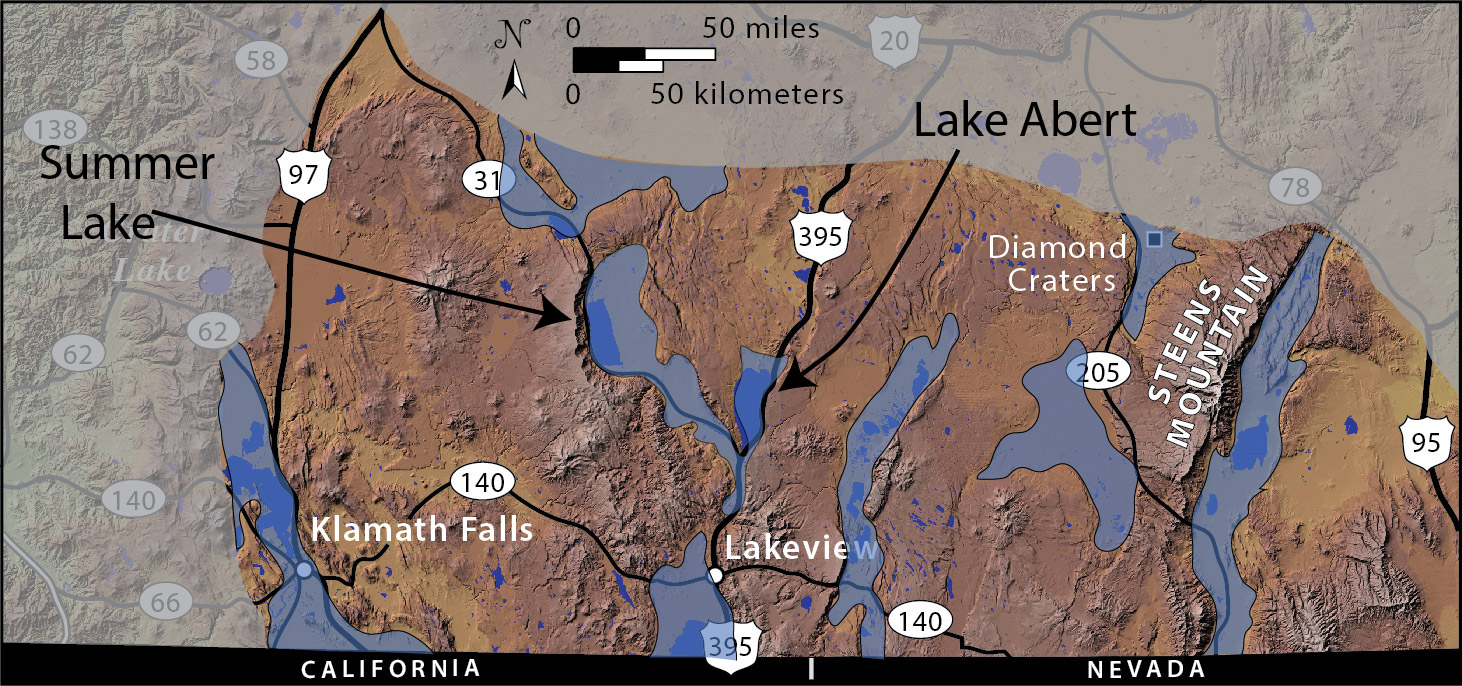
But think of what the lake was 20,000 years ago, at the height of the last glaciation!  The physiographic map below shows Lake Abert (along US 395) as part of the much larger Lake Chewaucan, which included the even larger Summer Lake basin to the west.  There’s all sorts of evidence for this earlier lake: old shorelines, deposits at elevations well above the modern lake, gravel bars.  And Lake Chewaucan was only one of many such Pleistocene, or “pluvial” lakes that occupied closed basins in the Oregon and Nevada Basin and Range.

Distribution of Pleistocene lakes in the southern Oregon Basin and Range.

Distribution of Pleistocene lakes in the southern Oregon Basin and Range.

Of course these ages do a “time-number” on me.  20,000 years is a short time, geologically.  So just yesterday, this region had many of these large large lakes –and in just a short time, they’ve dwindled to isolated remnants.  But in just the last 5 years, those remnants have dwindled even more.  It’s dramatic.  It’s frightening.

Odd too –those Young Earth Creation types think that planet Earth is younger than Lake Chewaucan!  And really?  Lake Chewaucan couldn’t have formed unless there was a basin there –and do you see the cliffs on the right (east) side of the lake?  That’s Abert Rim, uplifted by a big normal fault –which is what formed the basin.  So, the 2000′ of  uplift on this fault must be older than the lake, which is older than planet Earth!  Cool!


For more photos of Lake Abert, type “Lake Abert” into the geology search engine.
For information about the completely new (available in November, 2014) Roadside Geology of Oregon book.

Geologic history of the western United States in a cliff face in Death Valley National Park

Of the many geologic events that shaped the western United States since the beginning of the Paleozoic Era, five really stand out.  In approximate chronological order, these events include the accumulation of tens of thousands of feet of sedimentary rock on a passive margin, periods of compressional mountain building that folded and faulted those rocks during much of the Mesozoic–likely driven by the accretion of terranes, intrusion of subduction-related granitic rock (such as the Sierra Nevada) during the Jurassic and Cretaceous, volcanic activity during the late Cenozoic, and mountain-building by crustal extension during the late Cenozoic and continuing today.  This photo on the western edge of Panamint Valley in Death Valley National Park of California, captures all five.

View of canyon wall on west side of Panamint Valley in SE California --part of Death Valley National Park.  See photo below for interpretation.

View of canyon wall on west side of Panamint Valley in SE California –part of Death Valley National Park. See photo below for interpretation.

The photograph below shows an interpretation.  Paleozoic rock is folded because of the Late Paleozoic-early Mesozoic compressional mountain-building; it’s intruded by Jurassic age granitic rock, an early phase of Sierran magmatism that took place just to the west; the granitic rock is overlain by Late Cenozoic basalt flows, and everything is cut by a normal (extensional) fault.  And there is also a dike that cuts the Paleozoic rock –probably a feeder for the basalt flows.

Interpretation of top photo.

Interpretation of top photo.

So this is all nerdy geology cross-cutting relations talk –but here’s the point: in this one place, you can see evidence for 100s of millions of years of Earth History.  Earth is old old old!  THAT’S why I love geology!

And for those of you who crave geologic contacts?  This photo has all three: depositional, between the basalt and underlying rock; intrusive, between the Mesozoic granite and the folded Paleozoic rock; fault, the steeply dipping black line between the basalt and the Paleozoic rock.  Another reason why I love geology!


click here to see photos and explanations of geologic contacts.
or click here for a slideshow of Death Valley geology.

Geologic Time in a mountainside –the Wallowa Mountains from Joseph, Oregon

Joseph, Oregon is a wonderful place for geology.  The town sits right at the foot of the Wallowa Mountains in the northeastern corner of Oregon.  The mountains rise some 4-5000′ abruptly from the valley floor along a recently active normal fault.

The Wallowa Mountains rise along a fault zone just south of the town of Joseph.

The Wallowa Mountains rise along a fault zone just south of the town of Joseph.

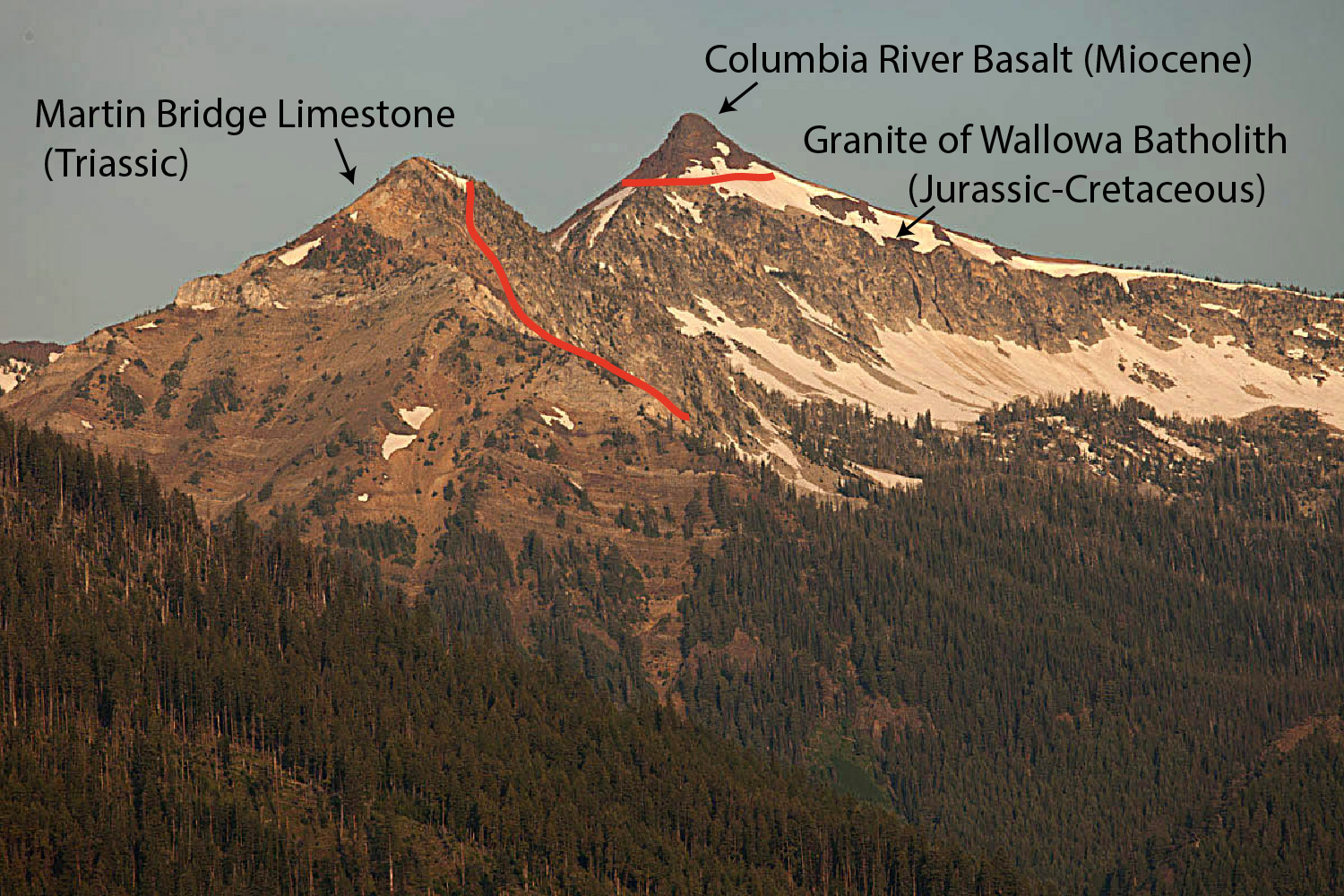
In the mountains, you can see some bedrock relations that speak to great lengths of geologic time.  An erosional remnant of the Columbia River Basalt Group caps Sawtooth Peak in the photos below; it sits directly on granite of the Wallowa Batholith –and just a little bit south, on the next peak, the granite intrudes Martin Bridge Limestone!  So, from oldest to youngest, the rock units are the Martin Bridge Limestone, the Wallowa granite, the Columbia River Basalt.

Sawtooth Peak (right) capped by Columbia River Basalt.  Beneath it is granite of the Wallow Batholith --and off to the left, are the bedded rocks of the Martin Bridge Limestone.

Sawtooth Peak (right) capped by Columbia River Basalt. Beneath it is granite of the Wallowa Batholith –and off to the left, are the bedded rocks of the Martin Bridge Limestone.  See below for labels.

Rock units and contacts described in the text

Rock units and contacts described in the text

Never mind that we know the Martin Bridge Limestone is Triassic –so more than 200 million years old –and that the Wallowa Batholith formed at different times between 140 to about 120 million years ago –and that the basalt is about 16 million years old.  You can throw out radiometric dating, but even so, you’re looking at a great span of geologic time.  The limestone first had to be deposited, layer after layer –and then buried –and then intruded at a depth of 5-8 km by the granite –which THEN had to get uplifted to Earth’s surface so the basalt could flow over it.  After THAT, it all had to get uplifted to its present elevation along the normal fault just south of town and much of the basalt had to erode away.

Honestly, we have influential people in this country who spout off things like the Earth is only 6000 years old.  They also deny the overwhelming evidence for climate change.  I guess I should stop writing now before I get too worked up!


More photos of the Wallowas at Geologic Photography.

Glacier National Park –Proterozoic rock and fossil algae

Glacier National Park’s one of my favorite places.  It’s soaring cliffs, waterfalls, and colors are positively amazing –especially the colors.  Green green vegetation, and red, white, green, and tan rocks.

To think that these mountains were carved from sedimentary rock that was deposited at sea level and now host glacial cirques and valleys, and even a few remaining glaciers… The rocks are part of the so-called “Belt Supergroup”, which was deposited probably in a large inland sea over what is now much of western Montana, northern Idaho, eastern Washington, and southern BC and Alberta.

Peaks of Glacier National Park and St. Marys River.

Peaks of Glacier National Park and St. Marys River.

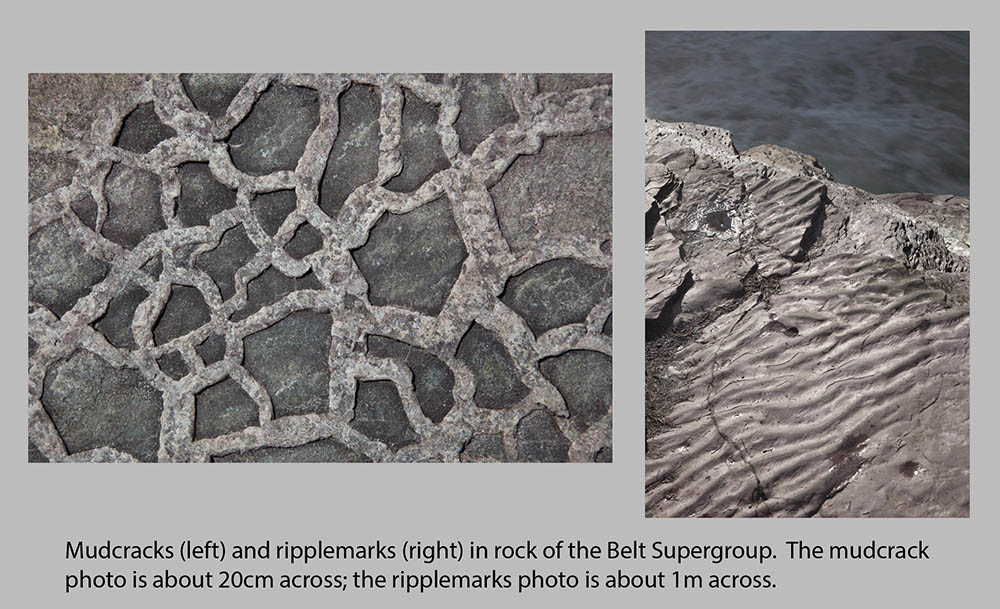
And the rocks are really old–radiometric dating has them as between about 1.4 and 1.5 BILLION years old.  Even without that knowledge though, you can guess they’re pretty old because, just about everywhere, they host fabulous sedimentary features like cross-beds, ripple marks, and mudcracks.  The sediments were deposited before critters were around to stir up the sediment.

Belt sedsrs pic

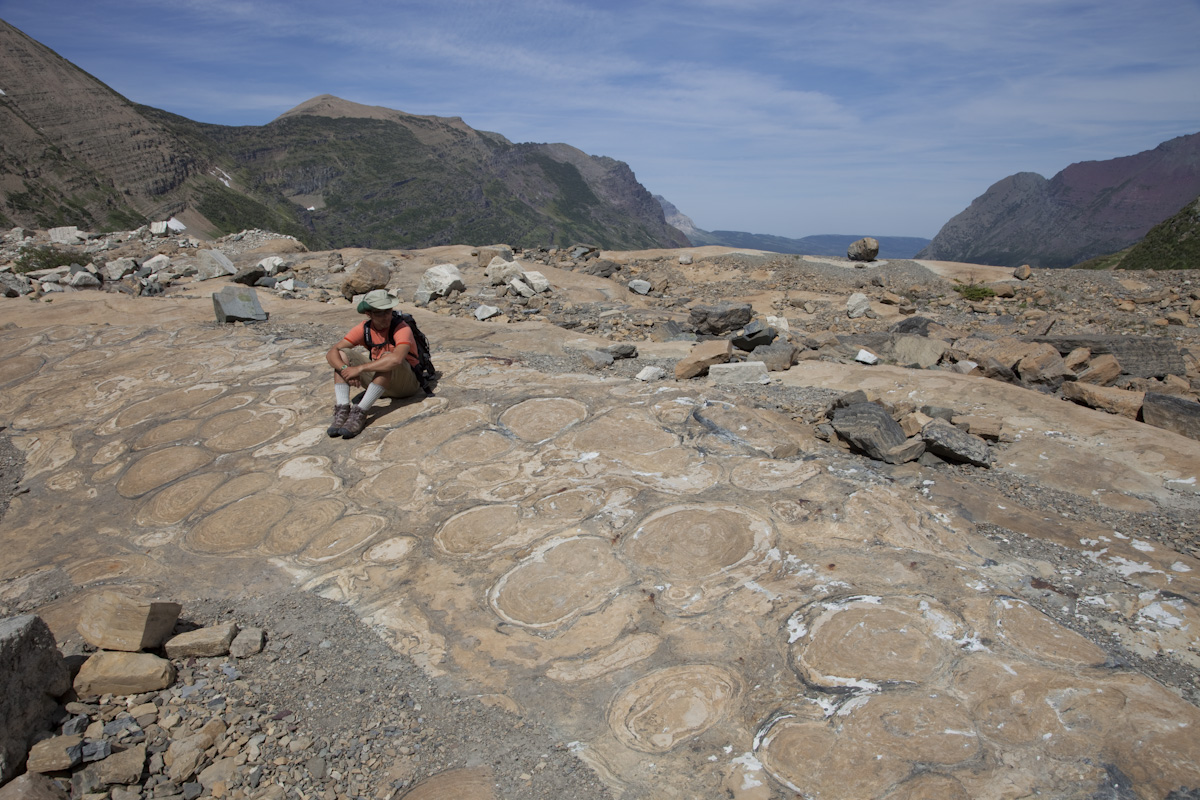
There are some fossils though: stromatalites, which are basically fossilized algae.  The algae grew as mats on the ocean floor, and because they were kind of sticky, trapped carbonate sediment.  Then they grew over the sediment –and then trapped more.  And more –until they created a mound, which in cross section looked like the photo just below –and in plan view, looked like the bottom photo.

cross-sectional view of a stromatalite in the Proterozoic Helena Formation, Glacier NP.

cross-sectional view of a stromatalite in the Proterozoic Helena Formation, Glacier NP.

Stromatalites of the Helena Formation as seen in plan view.

Stromatalites of the Helena Formation as seen in plan view.


for more photos of Glacier National Park, type “Glacier National Park, Montana” into the  geology photo search.
Or click here for a freely downloadable geologic map of Glacier National Park.

Today’s hazards, yesterday’s hazards: Earthquake damage, ongoing rock fall, and basalt flow

The M 6.3 February, 2011 Earthquake in Christchurch, New Zealand caused more than considerable damage; 185 people lost their lives and estimates of damage now exceed $40 billion.  When I visited in January, 2014, there was still clear evidence of the destruction, such as this broken house teetering on the edge of a cliff face.  The cliff had apparently given way during the earthquake and taken the entire back yard with it.  Now, rock fall provides an ongoing hazard –hence the stacked shipping containers to keep it off the road.

And then there’s the lava flow –Miocene in age, filling an ancient river channel, as plain as day.  Some 10 or 11 million years ago, this lava flow probably burned everything in its path.

140127-28

photo downloaded from marlimillerphoto.com (type “New Zealand” into the search)

Glacially carved granite in Rocky Mountain National Park, Colorado

This landscape is so smooth and rounded that you can easily imagine the ice that must have covered it some 20,000 years ago.  And the ice must have been deep!  Look halfway up the mountain in the foreground on the left; it shows a distinct change of rock weathering akin to a bathtub ring–and the ring persists around much of the photo.  It likely marks the upper surface of the ice at maximum glaciation.

140809-94
Upper Glacier Gorge, a glacial cirque in Rocky Mountain National Park, Colorado.  View of the Spearhead (left) and McHenry’s Peak (just behind)

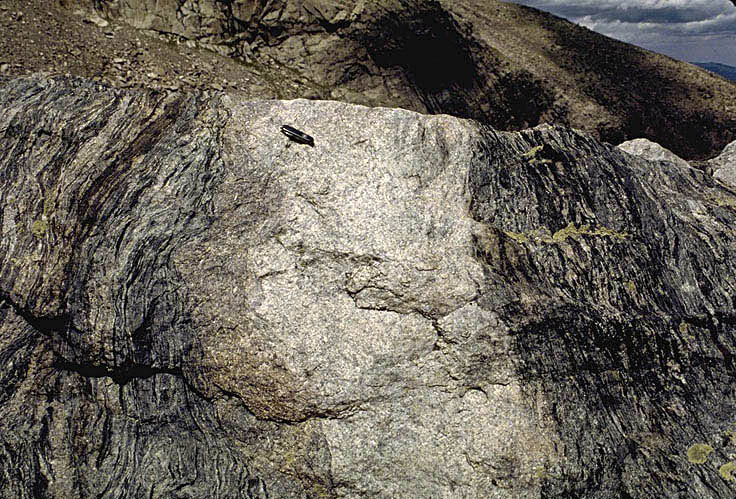
Like most landscapes, this one’s pretty young–and those glacial effects are even younger.  When compared to the age of the rock, it seems almost insignificant.  The granite bedrock, which is granite, is 1.4 billion years old!  Elsewhere in Rocky Mountain National Park, the granite intrudes even older metamorphic rock –1.7 billion years old.  Just .3 billion years older.  I think we forget that “just .3 billion years” is 300 million years –about the same length of time as the entire Paleozoic!  And the Pleistocene Epoch, during which the glaciers grew?  It started some 2 million and ended about 10,000 years ago

Granite sill intruding gneiss, Colorado.
1.4 billion year old granite intruding 1.7 billion year old gneiss in Rocky Mtn National Park.


images can be downloaded for free at marlimillerphoto.com

Post Navigation